This video song appears to be a last call of the Heathen in Norway before it fell completely to the Christian yoke - a call as to who would then hear the call of the Sacred Runes.
Ar-Kan Rune-Lag

Saturday, 22 September 2018

The Mother Rune - Nine Glory-Twigs

This is the original 'Nine Glory-Twigs' which is just one version of this 'Mother-Rune' since Hamasson re-drew this in a way that makes a continuum from the Armanen Runes.

At our annual Nottinghamshire Folk-Moot I did a short seminar showing the 'Mother-Rune' in the form above. This uses nine 'sticks' or 'Glory-Twigs' placed within a hexagon-shape. From this shape all 33 Runes can be found, thus forming the 'Mother-Rune' out of which the runes are drawn.
This carries further the form that Hamasson drew since it places the whole structure inside a hexagon. This creates the 'Seed of Life' and the 'Tree of Life' and is in total balance. The figure is very interesting -
- There are 24 triangles within the whole.
- The central hexagon is the Hag-All/All-Hag of the Armanen System.
- The central figure, as well as the Hagal-Rune, is the Gar-Rune.
- Alternatively, the central rune can be seen as the Germanic Ing-Rune.
The figure can be used as a Mandala by making it out of wooden staves - nine long staves and six half-staves. To make this even more effective either glue the pieces into place or make the wood with a diameter wide enough to drill a small hole and pin together with suitable pins. Gluing would be the easiest since the pins would need to be different sizes. To make this effective it should be made with 9 inch staves for the 'twigs'. The others will be half that size.

Tree of Life
Edel Rune - Blood & Soil
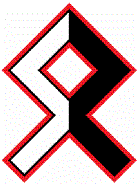
It always seems controversial when you give the meaning of the Edel-Rune as Blood & Soil; yet this is the best way to describe this rune. There are various rune-sounds given to this -
Odal
Othala
Edel
Ethel
If we trace this back to its original root this is - *at-al - the Indo-European Root-Form which means 'race'. There is also an Old Icelandic athal which has two meanings -
- nature, disposition
- chief, head, principle
'Nature' or 'disposition' means 'inherent nature of something' meaning the essence of something such as the inherent qualities of a man. These are the qualities that an individual possesses, but can also mean the qualities that a tribe, nation or race possesses.
The terms 'chief', 'head' or 'principle' ('first') refer to someone in supreme authority such as a Tribal Leader, a King or a Ruler of some kind. This is where we get the meaning 'noble' from and words such as the Old English AEthelinga which refers to 'nobility' or 'aristocracy'. Note how near the Old English AEthel comes to the original *at-al. Thus both the Old English and the Old Icelandic come closest to the original form.
The term 'inherent nature' refers to the 'Blood', and the alternative meaning of 'Ancestral Homeland' refers to the 'Soil' - hence the term Blood & Soil. But we use the meaning 'Ancestral Homeland' in a specific way since we regard our 'Ancestral Homeland' as being the ancient land of At-al-land, which I spell this way because it is thus easy to see how it is made up of -
at-al = race
land = land/homeland
Thus meaning 'Race Homeland' or 'Racial Lands' which is where our Folk developed in the far distant past. Whether this is the lost Atlantis matters little since the name serves for an Archetypal Myth and we do find the name Atland in the Oera Linda Book. This can also be spelt Altland or Aldland which presumably stems from 'old-land' but which, I feel, may well be a misinterpretation of the original, or even a double-meaning given to the word by ancient seers.
There is also another meaning given to the Root *at-al and that refers to 'man' and to 'over' or 'beyond', hinting at the Overman (Superman) or the 'man who goes beyond' which refers to the evolutionary-drive towards immortality, going beyond the human state as we know today.
The rune-stave as shown above (work of Hamasson) tells us that the Edel-Rune is made up of two Sieg-Runes back-to-back, and in this case one white and one black - Black Sun-White Sun. This is also the 'Union of Opposites' which, within our own Wodenic Lore, has to be the 'Sacred Marriage' that takes place, after which the Initiate goes beyond in order to create the Absolute 'I' (Miguel Serrano).
It is important to note that this is one of the runes that has the hidden meaning of 'Gift of Ing' being a bind-rune of Gyfu and Ing (Elder Futhark). The Ing-Rune is also a bind-rune of -
- Two Gyfu-Runes
- Two Edel-Runes
The Ing-Rune is the Rune of Blood (DNA Spiral) and it would seem that some scientists now believe that within the DNA is an encoded 'survival gene' which means that the survival of one's Folk is encoded in our DNA. Seemingly, those who betray their Folk and Nation do so because they have lost this 'survival gene' or perhaps it has been mutated through their stance on self-destruction, which is what they do - self-destruct. The Ing-Rune also has the meaning 'Gift of Ing' through its bind-runes of Gyfu and Ing. The two Edel-Runes make this a symbol of the Divine Twins joined at the head, a symbol that is very ancient I believe.

The Ing-Rune with the 'crown' of the 'Crowned and Conquering Son' which Hamasson pointed out. This also adds a Germanic Kenaz-Rune to the Edel-Rune which relates the whole thing to 'Fire', kingship actually being related to 'Fire'. This is not only a physical 'crown' but also the hvarena which is the 'Fire of the Aryan Race'. In the stave shown on the right we have the Kenaz-Fusion version of the Ing-Rune - again 'Fire'. In fact, within the Ing-Rune we do have two different forms of 'fire' -
- Fire as the physical form.
- Fire as the 'action', i.e. the Inga-Fire or Agni-Fire. This is the 'element' known as 'fire'.
The 'crown' on any 'holy man' can be seen as a Halo of Light, a bright golden ring around the head. This is the 'Crown of Glory' or the hvarena which is the sign of true Sacral Kingship. We are back to the Old Icelandic meaning of 'chief', 'head' or 'principle'.
The Aryan Root *at-al gives us variations of names given to women, all names based upon this rune, and all having the meaning 'noble' -
Adelle
Adela
Edele
Adelaine
We should also remember that the two versions of the word using either 'd' or 'th' are merely slight alterations in the sound. Sometimes I write this as 'dh' which may come closer to the original sound - where the 'd' is sounded but with the lips as 'th'. If you practice saying 'd' you will notice that the tongue touches the upper part of the mouth, but when doing the 'th' as in 'thin' it touches the teeth with the sound at the back, but 'th' as in 'the' is the same but sounded at the front of the mouth. If you touch the teeth and sound 'd' we get 'dh', the sound in between the two.

This is a variant of the Edel-Rune, usually called the Erda-Rune, the name suggesting the 'Earth' or 'Mother Earth'.
Thursday, 20 September 2018
Rune-Chants - Gealdor
We use the following rune-sounds within the Ar-Kan Rune-Lag System -
Feoh-Ur-Thorn-Os-Ken-Gyfu-Wyn
Haegl-Nyd-Is-Ger-Eoh-Peorth-Eolhs-Sigel
Tir-Beorc-Eh-Mann-Lagu-Ing-Daeg-Edel
Ac-AEsc-Yr-Ior-Ear-Cweorth-Calc-Stan
Gar
As you can see these are broken into four sets of AEtts, four sets containing eight runes each. The Gar-Rune stands alone as the Sacred Centre - the Spear of Woden.
These are the names that have come down to us from the Old English Rune Poem so we have used them as they are. However, for rune-gealdor (rune-chanting) we have found that these do not really fit the idea of chanting since many of them are single-syllable sounds. Two-syllable sounds seem to work better, and in line with this I am going to suggest the use of the following sounds, still retaining the essence but recreating them using the Elder Futhark as a guide.
Feoh/Fehu-Uruz-Thunaraz/Thurnu/Thuraz-Oski-Kenaz-Gebo/Gyfu-Wunyo
Haegl-Naudiz-Isa-Yeara-Eiwhaz-Peorth-Eolhaz-Sowilo
Tiwaz-Berkan-Ehwaz-Mannaz-Laguz-Ingwaz-Dagaz-OEdel
Acaz-AEsciz-Yruz-Ioraz-Earaz/Earthaz-Cweorth-Calcaz-Stannaz
Garal
I have made certain key changes to this because I feel that some of the rune-meanings do not quite fit with our weltanshauung. No doubt this will be open to criticism but I see no need to retain stuff that is not what we need or seems rather out of place. I am going to go through the runes and give reasons for the changes.
Feoh/Fehu - This rune may be better used in either version according to the use needed for the runes; fehu is the Proto-Germanic word for 'cattle' whereas Feoh can also be 'light', 'fire' and 'fight' which is an alternative meaning.
Uruz - this needs no explanation and has been substituted for Ur, both have the same meanings.
Thunoraz - This is the Proto-Germanic root-sound for 'thunder' and thus for 'Thor'. Thurnu is the Proto-Germanic root-sound for 'thorn' which replaces the Old English form. Thuraz stems from Thurs which is a name of the 'Giants' and may be the 'Joten', although we do not really know if they are the same or different aspects of the same. We get 'Thursday' from 'Thurs-day' though some derive tis from 'Thunor's Day'. In this respect I feel that we should leave this one to the individual to use as they feel right. Whichever rune is used would invoke the power of the sound - an important point to note in using the rune-sounds.
Oski - This is a very difficult one since the rune-name Os can have two distinct meanings, one from the Germanic source (Os = Ash-Tree) and one from the Latin source (Os = Mouth). We can assume that the Old English used Os in a different sense than the Germanic for 'Ash-Tree' since the later AEsc-Rune means 'Ash-Tree'. This is no doubt why this rune is said to mean 'mouth', so we have kept this as it is but added the -ki making 'Oski' which is a by-name of Woden.
Kenaz - Keeping the same root-sound as 'Cen' but using the hard 'K' to differentiate from the 'C' which can be a soft sound.
Gebo - This is the Proto-Germanic form for 'gift' which is a later variation; either form could be used however.
Wunyo - The Old English Wyn may have been pronounced 'woon' as in the word for 'king' - Cyning. It is thus easier to spell the name 'wun-yo' to make the sound clearer, where the 'u' is 'oo'.
Haegl - I see no need to use the form Hagal here since the 'g' would be silent anyway; thus Hae-gl would be used as two syllables and pronounced 'hay-el'.
Naudiz - This is the Proto-Germanic form which is older than the Old English; it should be mentioned that all of the meanings related to 'need' were originally forms used to mean 'death', something to think about when using this rune-stave. This is probably where the 'Nithing Pole' stems from since it is a 'Cursing-Pole'. It is also likely to be connected to the dragon-serpent Nidhog which lies at the bottom of Yggdrasil.
Isa - This is obvious, merely adding the '-i' so as to form two syllables.
Yeara - I see no reason to use the form Ger since we all say 'year' and this rune does not bear the 'G' sound as does 'Gyfu' and 'Gar'.
Eihwaz - This form is closest to the IE Root *aiw- which refers to the 'Life-Force' and also to 'Eternity'. This is a force that is beyond Time and Space and works in Eternity and the Infinite. The sound 'Eoh' is merely a variation.
Peorth - (Spoken 'Pey-orth' as two syllables) - I have retained this for good reason, since very few rune-workers have ever really given a truly valid meaning to this rune - it is still a 'mystery' really. We see it as the Rune of Wyrd ('Weorth') and also the rune-stance used when playing the Taefl-Board, also representing the 'Dice-Cup' used for this game (originally, that is). There seems little sense in changing this to 'Perthro'. There are some interesting meanings to the root from which 'worth' stems -
- High raised spot (wart).
- To raise, to lift, from which stems the word 'aura' from the Greek meaning 'breath'.
- To turn, to wind, to coil, from which we get 'to become' and the OE Weorth meaning 'worth'. The Root *wergh means 'to turn' and gives rise to roots meaning 'to strangle'. This also gives rise to the Root *wrmi- meaning 'worm', giving OE wyrm and Germanic *wurmiz.
- To perceive, to watch out for, giving rise to our 'aware'.
- To cover.
- To burn.
- Squirrel through Latin viverra meaning 'ferret'.
Wyrd is indeed 'becoming' and also connected to 'worth' which is the basis of karma but rather different in many ways.
There are also some interesting root-words stemming from the IE Root *per- as shown below -
- 'Forward', 'through' in the sense of 'in front of', 'before', 'early', 'the first', 'chief' etc.
- 'Around' or 'Beyond'.
- 'Forefather'.
- 'To further' i.e. 'to improve'.
- 'Before' or 'forth'.
- 'Former', 'higher' or 'superior'.
- 'First' or 'foremost'.
- 'Going before'.
- 'To lead', 'to pass over'
- A crossing over, a journey (to fare).
- To try, to risk in the sense of 'to lead forward' or ' to press forward'.
- To strike.
- To sell.
- To get, to beget.
The Latin parcae stems from the IE Root *pera- and here is a direct link with the Wyrd Sisters or Sisters of Fate who are certainly linked to this rune.
We should also consider that the rune-stave is shaped like the Berkan-Rune 'opened out' and since the Berkan-Rune shows a pregnant mother-to-be this is this mother giving birth.
Eolhaz - The sound-change is very subtle and makes hardly any difference from Elhaz. However, the use of the term 'wounds' infers that this rune should be sounded as elk-az since the IE Root *elk-es means 'wound' from which we get the Latin 'ulcer'. This could relate to the Elk as symbolic of protection and defence. The 'h' sound may have been much like the use of this letter in Germanic Tongues sounded as the ch in Scottish 'loch'.
Sowilo - The IE Root *saawel- means 'sun' and this is where 'Sowilo' comes from; this is usually said also to relate to 'soul' and thus a play-on-words which has some sense in it.
Tiwaz - The form 'Tir' is the Norse name for 'Tiwaz' and the reason why it occurs in the OE Rune Poem is not known; we can use this in its original Proto-Germanic form as 'Tiwaz'.
Berkan - The birch-tree is named after the IE Root *bherag- which means 'to shine' 'bright', 'white' etc. This becomes the PGmc Root * birkjon. There is another variant of this in the IE Root *bherak meaning 'to shine' or 'to glitter'. These all describe the Silver Birch with its 'shining' bark, but they could also refer to the Moon through the link between 'silver' and the Moon.
There is also an IE Root *bhergh meaning 'to hide' or 'to protect' and also 'to bury', as well as meaning 'high' as in a 'berg' or mountain. The Old English burgh is linked to a mound and burg to a 'town' or 'fortified place', though the latter does suggest that originally this was a fortified place upon a hill or mountain. These were originally hill-forts.
Ehwaz - the form 'ekwo' is the original IE Root and Ehwaz is the Proto-Germanic form of this.
Mannaz - obvious, just adding the -az sound on the end to form a two-syllable form.
Laguz - the same.
Ingwaz - and again, and since the original form seems to be Ingui this makes sense.
Daegaz - we retain the ae dipthong sound.
OEdel - We already have an 'e' sound and also an 'o' sound so using the 'oe' dipthong makes some sense. The original IE Root *at-al is the root from which this developed.
Acaz - we have added the -az ending.
AEscaz - as above, but retaining the root-meaning of 'ash' because (like 'Ansuz') this refers to the Ancestors.
Yruz - Formed as 'Ur-uz' and sounded 'ooruz' rather than 'ur-uz'.
Ioraz - This is a very difficult one since the rune-name Ior can be found in Iormungand where the sound iormun is similar and related to ermin and Irmin, all of which seem to relate to 'mighty' and to 'strength'. We find this in Eormenric which would mean 'Mighty Ruler'. I find it wise to merely add the '-az' sound to this.
Earaz/Earthaz - Again this is a very difficult one since again we have little to go on except a link to the 'earth-grave' and thus to 'earth'. There is an IE Root *er- meaning 'earth' from which this no doubt stems. And yet the sound *ar means 'eagle' and this too can be related to this rune - the OE word for 'eagle' is earn. There is also a PGmc *raizjan meaning 'to raise', 'to rise' and 'to arise' which adds meaning to the rune itself.
Cweorth - The meaning of this rune is very uncertain, but some link it to the Celtic Ogham Quert which is linked to the 'apple'. The 'cw' becomes 'qu' which logically links the two together. We have an IE Root *gwer- which has the following meanings -
- 'Mountain', but originally linked to 'coming from the north'.
- 'Heavy' from which stems the OE cweorn meaning 'quern'.
- 'To favour'.
- 'To swallow', linked to the throat.
These meanings really do not help much I am afraid; we should now move to the alternative Sweorth meaning 'sword'. Here the root-meaning can be seen in one of the meanings to the IE Root *swer-
- To speak, to talk, whence the Old English swerian meaning 'to swear'.
- To buzz, whisper (imitative) giving us our word 'swirl' and 'whirl'.
- To cut, to cleave giving the Old English sweord meaning 'sword'. We have to note that this does not actually give us the rune-name sweorth, so a 'scribal error' would seem to be an inadequate reason to view the change from Cweorth to Sweorth. More likely this has two distinct meanings hidden in one form of the word.
- Heavy - it should be noted that here we do have a link between the word Cweorth ('heavy') and Sweorth ('heavy').
Since this rune-name seems to have two distinct meanings I am going to stick my neck out here and suggest a third - PGmc *swarta- which gives us Old English sweart and German swart both having the meaning of 'black' or 'swarthy'. The reason I have suggested this is because of the link between this rune and the Long Man of Wilmington which seems to be linked to one of the Grail Legends, and this particular legend mentions a huge black man who appears at this site, this being the 'Wild Man of the Woods' known in Germanic and Celtic Myths.
Calkaz - The IE Root *kal- gives us 'cup' or 'chalice' and the Latin calix; the root can also mean 'beautiful' or 'hard' and gives rise to the name of the Celtic Sword 'Excalibur' and the Latin Caliburnus meaning 'hard'. The root-meaning 'cup' actually comes from the Greek kalux meaning 'seed-vessel' or 'cup' which somewhat changes the equation. The meaning of this rune could thus be related to the 'pouring' out of seeds onto the Earth, and thus to 'seeding' or giving new life. Also, there could be a connection with the 'Water-Bearer', symbolic of the Age of Aquarius, who pours out the water from his pitcher onto the Earth - Seeds of Rebirth?
We have a link to Kalki Avatar here and to HelgiH since the PGmc Root *hal- is the equivalent to *kal-. Kalki 'descends' to Earth as the term 'avatar' tells us, for it means 'to dive' or 'the diver' whose symbol would obviously be the 'dove' which is the 'diver' and not originally applied to this bird. We also have the link with Kali and here there is a link to the last rune - Cweorth- since 'Kali' is not only 'Time' but also related to our word 'coal' which is black or swart. We have a kind of paradox here since the Latin calx means 'chalk' which is white and the link to black through Kali.
Stannaz - We have merely added the -az to the word 'stan' meaning 'stone'. There is one point here that is interesting and that is the IE Root *(s)ten which means 'thunder'. The 's' seems to have been dropped from this at some time.
Gar-al - I have changed this to link it to 'graal'; there is an interesting IE Root *garwian which gives gar giving us the Old Norse gera meaning 'to make do' and the noun-form *garwi meaning 'equipment', or 'adornment' or 'gear'. The spear is thus 'equipment' but the rune-stave itself is made up of the Ing-Rune and Gyfu-Rune making 'Gift of Ing' and G-ungn-R. The suffix *-al or *-el means 'light' which fits so well with the meaning Gar-al - the Spear of Light (this is borne out by the Spear of Lugh - one of the Four Hallows - which is the Spear of Light).
This is a very difficult subject to tackle and no doubt the rune-names will be changed again when new ideas come to light - which they invariably do. We should not be afraid to change, nor to admit mistakes when we make them. The truth is what matters, and we have to strive for this as best we can. We also need to remember that proto- merely means that the words are reconstructed from the material available, and invariably means speculation on the part of the scholars who do this work. This cannot be avoided since we really do not know for sure, though scholars that tackle this do so using certain 'laws' of letter-changes and sound-changes to try to be as accurate as possible. But again, we have to consider that these academics use logic alone, and sometimes the use of intuition and 'occult' techniques can be just as valid as logic. Roots with the same sound are often considered to give words with different roots, but there is a case for seeing sounds as forming links between different words with different meanings. Also the use of play-on-words as seems to be the case with Peorth and Cweorth. The word 'ash' can be either *as or *os which suggests a reason why these two were differentiated by using os and aesc in the OE Rune Row, the former used for 'ash' and the latter for 'mouth' (using the Latin meaning). We need to stick to the FUTHORK rather than the FUTHARK for the 33-Rune Row.
Monday, 17 September 2018
The Amber Nectar
In the ALU-ULA Exercise developed by the Ar-Kan Rune-Lag we make mention of the 'Nectar of the Gods' which is secreted after the 'Sacred Marriage' which takes place in the Higher Centre. This is interesting in view of certain things that I have just learnt from a source in Leicester. This involves the role of the 'Third Eye' in all this.
Firstly, it seems that scientists, in their efforts to experiment on anything that gives them 'knowledge' have found that in rats their Pineal Gland secretes DMT, the most powerful hallucinogen known today. This should explain to us why man has had to resort to the use of such substances as the ayahuasca plant used by shamans in Central and South America. When the Pineal Gland was active there would be no need for this, since the human body would naturally secrete such hallucinogens which would give visions to the shaman. This fact has not been widely published, nor has it been looked into.
Some yogis of India are said to go into a deep trance and force their tongue down the back of the throat in order to collect the substances secreted through their trance-state. This is said to have a 'sweet' taste, which we can see as the 'Nectar of the Gods'. It would seem that the 'Sacred Marriage' - at one level - is the 'marriage' of the Pineal Gland and the Pituitary Gland which somehow work together in this process. In the Chinese Tantra that I mentioned in previous posts a fluid is secreted that floods the body, this tasting like 'honey'.
In the ALU-ULA Formula the Ansuz-Centre is Odroerir ('Wod-Roarer') which is the cauldron containing the Mead of Inspiration - the 'honey-drink' of the Gods. It seems obvious that the Sacred Mead drunk by the Germanic-Norse and Celtic Folk was not just simple fermented honey but contained powerful forms of hallucinogen that would substitute for the loss of the power of the 'Third Eye', the secretion of the 'Nectar of the Gods' through the Pineal Gland and the Pituitary Gland.

The Pineal Gland secretes serotonin which is supposed to be linked to depression and other such moods when enough is not produced; having said that serotonin cannot be measured so this is just a theory. As seen above the Pineal Gland area is indeed very much like the Eye of Horus drawn in Egyptian Hieroglyphs.

The above shows the Pituitary Gland in the head, on the left being the Wewelsberg Order Castle as it was planned out to be when completed - which did not happen. This shows the Spear of Woden thrust into the Holy Graal, pointing at the area of the Pineal Gland & Pituitary Gland. The Pine-Cone was often seen at the top of the Caduceus, showing the link between the Fire-Serpent and the Third Eye.
It seems obvious that the movement upwards of the Fire-Serpent to the Third Eye involves the 'Sacred Marriage' (HE/SHE) which involves the balance of the Pineal Gland and the Pituitary Gland whence the Amber Nectar ('Nectar of the Gods' = Amrita/Ambrosia) is released. This is the Mead of Inspiration which is not just a physical drink made of honey, but is the secretion of the Mead of Inspiration in the physical body, but which takes place at other levels in order to release this.
From my own experience in the mystical experience/ Initiation that I undertook back in 1997 when the Third Eye opens everything becomes crystal clear. The mind is no longer in a state of wandering from thought to thought (symbolised by the hare/rabbit chasing around) but is clear and even in a dream-state thoughts can be controlled by the mind. This, I believe, is called lucid dreaming, and it can be brought about as I have seen for myself. This is something that will take years to master though and does not occur regularly.
Odroerir was the name of the cauldron or horn which contained the Mead of Inspiration, although there were Three Cauldrons with Son and Bodn. These, it must be remembered, contained the mead made from the Blood of Kvasir, whose name is related to the idea of 'fermenting' and thus to 'intoxication'. The Odroerir-Centre must be the Centre of Wod or the Woda-Force which itself relates to 'divine madness', 'intoxication' and 'divine inspiration'.
The Eye in the Triangle used as a Masonic Symbol and Illuminati Symbol must originally have been the 'Third Eye' since the Triangle is symbolic of this Higher Centre, the Inverted Triangle being symbolic of the Lower Centre. This is an ancient symbol and not necessarily 'evil' but which can be manipulated for evil purposes, as all symbols can.
We have to consider what an 'hallucination' really is, since it is today deemed something that is unreal, not part of 'reality'. But since today's 'reality' is fixed firmly in the physical, material world then anything else is dismissed as 'not being there'. Yet, our dreams are just as real to us whilst dreaming as our waking state is real to us. So which is 'reality' and which is 'not reality'. Both are as real as the other, merely different states of consciousness. Hallucinations are just different states of consciousness, a different 'reality' that exists beyond (and above) our 'waking state'.
Secretions such as serotonin and the secretion of DMT from the Pineal Gland are merely a chemical reaction that takes place in the human body, but one which can alter our state of consciousness and in doing so can give us insights into different realities - different worlds of being. Mind altering substances were used by shamans and wizards to gain altered states of consciousness because they mimicked the natural secretion of such substances that happened naturally before the loss of the Third Eye.
Shamans in Central and South America use the plant ayahuasca as a mind-altering 'drug', and from their experiences we can see how this came about. It would seem that centuries ago a particular shaman had a vision in which he was shown this particular plant which could be used for this purpose. This would infer that this shaman had foresight and knew that the human body would at some future time not be able to produce the mind-altering secretions needed, and that a vision showed him what could be used, and this knowledge was passed down until the time that it would be needed by future shamans. This would have been at a critical time when such psychic powers were fading and the shamans needed to maintain this power, but having to use external substances to achieve altered states of consciousness.
Wednesday, 12 September 2018
Subscribe to:
Posts (Atom)