Ar-Kan Rune-Lag

Ar-Kan Rune-Lag

Saturday, 19 February 2022

Heil & Sieg!


Hagal-Rune 


'Hagal is cold corn/and driving sleet/and snake's sickness'. Icelandic Rune Poem

This is the 'snowflake' rune which covers both hail, sleet, frost, and the flakes of snow - the pattern is of Ice. The inference here is of a 'seed' ('corn'), but I have no idea about the 'snake's sickness' - however, the mention of the snake may be important, so we'll not dismiss that. The pattern is also of Miguel Serrano's HE/SHE concept, which we'll look at later. This is also a Life-Rune - Death-Rune bind-rune -


The pattern is one of 'wholeness' (Heil) since we have here the Roots - Trunk - Branches of a Tree. Wholeness, Holy, Harmony, Health and Healing. The role of the Ar-Man as the one who 'fits together' that which is broken asunder by the Shadow-Forces. In both the Welsh, Breton and Greek tongues the word for 'Sun' is haul, hoel and helios; 'haul' is pronounced 'heil' as far as I know. (These may be from the older tongues.) Rather than the 'H' the Germanic Tongues (including the Irish here) use an S - Sun, Sal, Sol, Solar, Sowel, Sowilo, Sig-el, etc. (The Irish form means 'eye'.) So the Hagal-Rune and the Sig-Rune are linked together, and both can mean 'Sun' - this rune-stave is that of the Sun and its rays. 

'Hagal is coldest of corns/Krist shaped/the original home.' Norwegian Rune Poem.

Again, the idea of a 'corn' or 'seed'; and here, as I have covered before, Krist was the shaper of the UR-Home (Urheim). Krist here is associated with Ingwe, and to the 'Holy Spirit' which is a 'Fiery-Spirit'. This gives us nothing new here.


'Haegl is whitest of corns/from heaven's height it whirls/winds blow it/it becomes water after.' Old English Rune-Poem.

This version refers not to 'cold corn' but to 'whitest of corns' and it uses certain terms - whirls, winds blow it, and that it turns into water. To turn ice or frozen rain into water again needs warmth and heat, so here we may have a hidden reference to Fire. That the wind whirls it suggests yet another reference hinting at Fire, which needs the movement of air to light and maintain its form. Maybe or maybe not, just some ideas here. The rune also shows HE/SHE but in the form of UR/RU, the Ur-Rune and its reflection. 

The aim of the Global Elite is to make themselves 'immortal' through the means of the 'Immortality of the Cells'. Once more, this is a sick parody and copy of the true road to the Immortals - the Immortality of the Soul. Miguel Serrano covers this topic in his usual style, and it can be found in the Manual of Khshnoom where the Male-Female Souls unite to create the 'Total Man' (Serrano). The Manual tells us that the aim is of the Perfected Soul - Magovan - who is I-e-Su, a passionless birth. It also tells us that this is the Will of God - AHU using their own words. This, then is the true Path of Evolution as set put by the God-head, as opposed to the false path of immortalising the physical body. There is no doubt that there have been some who have mistaken the process for what it really is - Spiritual Evolution. 

Way back in 1981 there was a film called 'Artemis 81' which I have covered before, since it features a battle between Light and Dark, and of a virus that affects the people of one area. It is a strange film which uses the word 'asexual' crossed out - as if emphasising this. The same night as I watched this I had a strange dream in which was a powerful symbol - A Five-Pointed Star (Blue-Black if I recall) and a Sig-Rune in Red. I was told that the Sig-Rune symbolised 'Magical Socialism' and the Five-Pointed Star 'Man Asexual'. I have never used the symbol, but it does seem to be relevant now after learning these things. The Five-Pointed Star is the Star of Venus, which tracks its movement through a cycle; it is also a symbol of Man. Five, according to Miguel Serrano, is a number of Hyperborea.


There are certain other words connected to 'Heil' -

Haele - Hero/Chief/Brave Man.

Hael - Omen.

Haeleth - Hero.

Haeland - 'Saviour' (*).

Halig - Holy (Selig, also Old English, means almost the same - blessed, holy).


Helgi - The Hallowed One - is a Wulfinga and 'Scion of Ingwe'; his Archetypal Myth is somewhat different than that of the more famous Sigurd-Siegfried. Sigurd-Siegfried falls from grace when he forgets his Waelcyrge-Love and takes on a mortal wife; even though he cannot really be said to be blamed, since he was drugged into doing so. Nevertheless, had he cemented the Sacred Marriage between himself and Sigdrifa-Brunhilde as HE/SHE in a Spiritual Union, he would have achieved Immortality. But he did not and his slaying by Hagon with a spear may well have been the judgement on this from the Gods. He also took the Rhine-Gold, which was then thrown back into the Rhine where it belongs. Helgi has a Waelcyrge-Wife and they are not separated even in death. Here we see that nothing in the future is set and here we have two different choices within one archetype. Tolkien reinstates Sigurd as the World Saviour in his version of the tale, which is quite interesting. I have used this here because it fits perfectly with the theme - Hagal-Helgi and Sig-El - Sigurd. 


The Sig-El Rune is the Rune of the Sun; it is also the Rune of the Serpent, as seen by the shape alone - the snake slithers in this form, and also it hisses which again can be seen in the S-sound. (There may be something in this, since some old tongues, including Old English, roll the Rs; maybe the use of a sssss sound for this rune does something in regard to vibration.) This is also the Lightning-Bolt, which we featured in the 'Heil and Luck' on the Inglinga Blog - the Hvarena again. 

The rune-name Sowilo/Sowalo refers more to the 'soul', since this means 'swift-moving' referring to the ability to send the soul out of the body. The names Sol (Sun) and Soul pair up in this respect. Armanen Masters and Adepts used these formulas -

Sal and Sieg!

Alaf Sal Fena! - 'All-Hael (*) and blessings to the Power-Born!'

Heil and Sieg! - 'Hale and Victory!'

(*) Sometimes 'salvation' but 'heil' sounds better to me.


Tuesday, 15 February 2022

Ingwe & HelgiH the Third.


Helgi Hjorvarthson is reborn as Helgi Hundingsbane, Helgi Hundingsbane is reborn as Helgi the Haddinga. Each one has a Walkyrie-Wife - Svava, Sigrun and Kara. The last name 'Kara' is an equivalent to the male 'Kari' of Niall's Saga, and maybe even to Kali of the Hindus. Kari and Kali are both related to 'time' in the sense of a 'movement of time' - wind. The 'Lay of Kara' was never found, only mentioned of, but maybe it has as yet not been written. Helgi Hundingsbane is called 'The Scion of Ingwe', and thus in a sense an 'offspring of Ingwe'. He is a Wulginga, close kin to the Wolsungas; indeed he is the Son of Sigmund, half-brother of Sigurd the Dragon-Slayer. 

We find a place in Norfolk, East Anglia, named Walsingham; this is named after the Waelsingas - the Wolsungas. The East Angles were ruled over by the Wuffingas - the Wulfingas. Just above Edinburgh in the Scottish Lowlands is a place named Haddington, clearly derived from the Haddingas; this area was one occupied by the Angles. We have here the Three Royal Lines of the Angles - Wolsunga, Wulfingas & Haddingas. The Old English Rune-Poem mentions the Heardingas (an alternative name) under the Ing-Rune, which has to be significant. In Spellcraft Kathleen Herbert has a chapter named The Everlasting Battle which features Heoden, King of the Wulfingas, and the Heodeningas, named after him. Whether this tribe is the Haddingas/Heardingas is not certain, but the name is linked to Hedhin meaning a 'short hooded cape' - usually something like a Wolf-Skin. 


Helgi Hjorvathsson found a sword at Sigarsholm with a Red Serpent on the blade and a Coiled Snake on the sword-guard. He was told of the sword by the Walkyrie Svava, and he did great deeds using it. Helgi had a brother named Heathin: Kathleen Herbert uses this in here tale about the Everlasting Battle. Heathen meets a 'Witch-Woman' riding a huge Wolf; she is ugly and asks Heathen to lay with her, which he does not. This is an old Aryan Tale in which an ugly woman asks a hero to lay with her, and the one that does turns her into a beautiful maiden. The Witch-Woman is the Fetch (Fylgja) of Helgi. But here it should be noted that the 'Witch-Woman' riding on the Wolf is the symbolism in a dream of one of the men in the Norwegian Army that tried to invade England. This seems to be a 'Personal Fetch' but also a 'Kin-Fetch', and is the Guardian Goddess of the English. 

Twas in olden times, as Eagles screamed

and holy streams flowed from the Heaven-Fells,

when in Bralund Borghild bore to the world

a hero high-hearted, Helgi by name.


At night in hall the Norns did come,

to the lord they allotted his life and fate;

to him awarded under welkin most fame,

under heaven to be among heroes first.


His fate-thread span they to overspread the world

(for Borghild's bairn) in Bralund Castle;

they gathered together the golden threads,

and in moon-hall's middle they made them fast.


In East and West the ends they hid:

the liege lands lay there between;

on the Northern side, Neri's Sister

did hang one end to hold forever.


One evil only the Wulfing threatened,

the maiden eke who the aethling bore:

...................................................

Croaked a raven hoarsely, on high-tree sitting -

hunger gnawed him - 'I know something'.


In his bernie stands who was born at night,

King Sigmund's son now the sun is risen!

His eyes flash fire, aethlingawise:

he will feast the wolves fain let it be!


....Hail to thee hero! In happiness live,

Yngvi's Scion, hold sway over men....


First Lay of Helgi Hundingsbane.


The time-span for this appearance of the Archetypal Hero - Helgi - appears to be at the start of the Age of Iron; this is why his mother is concerned, because he has been born to kindle war and strife. This is why the hunger gnaws the Raven, and that he will 'feast the wolves'. Helgi was fostered by Hagal, and whilst with him he had to wear the clothes of a bondmaid and turn the mill wheel; this tells us that this is linked to the Precession of the Equinxes and to the change of one world-age to another. Helgi was slain by Dag ('Day') at Fetter Grove. Helgi and Sigrun are said to have been reborn as Helgi Haddinga and Kara, daughter of Halfdan, as told in the 'Lay of Kara'. 

That this is a Primal Archetypal Myth can be seen in the opening line where 'Twas in olden times' is translated from Ar var Alda which means 'Primal Time' or 'First Time' - the Age of the Gods. Thus we can say of this Folk-Hero -

"I was Helgi, Son of Hjorvarth; I am Helgi, the Hound-Slayer; I will be Helgi the Haddinga."


Helgi - The Hallowed One.


The rune-stave here is made from a piece of an oak-barrel given to me when I was in the Scottish Highlands; it comes from the 'Burning of the Clavvie' which is an old Heathen Festival held near the Moray Firth. 


Hale-Bopp Comet - Bab-Komet


Wednesday, 9 February 2022

Apples and Glastonbury


The Cweorth-Rune is equivalent to the Celtic-Ogham 'quert', related to the Apple-Tree. Since the rune is related to Valhalla, then it is also related to Avalon - the Island of Apples. We can perhaps surmise that the Golden Apples of Idunn - the Apples of Immortality - are given out to the Einheriar in Valhalla, that they may fight the 'Everlasting Battle'. 


This alternative version shows a similarity between the arm-position and the leg-position of the 'Dancing Warriors' on the Sutton Hoo Helmet below -


Again, we can perhaps surmise that the posture used formed the basis for the shape of the rune, like the Peorth-Rune and the Taefl-Posture. The spears pointing to the heel and ball of the foot has to have some importance, but I have no idea what. 

It was Woden that brought Ritual Cremation to the Folk in the North, and that the ashes be laid in a Burial Mound of the Kings and AEthlingas. This is the Rune of Ritual Cremation, whence the physical is transmuted by fire into the spiritual - the spirit is released that it may travel to Valhalla. 

The Sword of Hengest is named 'Battle-Flame' (Hunlafing Hildeleoman) and is the 'Hun-Bequest', passed from AEtla to Hengest, from the 'Hun' to the 'Engel-Kin'. As  Sweorth this rune can be connected to the Sword of Hengest, since this is a Rune of Fire. Ingwe is a Sword-God, though this is not made clear in what little we have bout our own Divine Ancestor. We do know that Ingvi-Frey gave away his sword for the love of Gerda (Earth); and that he awoke the fire within Her in order to thaw the frozen ice that enchained her in the Ice-Ages. 

As the Fire-Twirl this is the means by which the worlds were 'whisked' into Creation by Waendal (Mundilfore). Waendal is the god that wields the 'Fire-Twirl', and an alternative rune-name gives us more hints of this role - TRIS. TRIS is the name SIRT spelled backwards, and Surt is the Fire-Giant who destroys the Nine Worlds in the Fires of Destruction, that a New Creation may begin. This is the Dance of Shiva, who has this stance which is most likely a Fylfot-Swastika when the symbol is spun around. 

The connection between the 'Island of Apples' (Avalon) and the Golden Apples of Immortality (Idunn) is rather obvious, and that Idunn has to give the Apples of Immortality to the Divine Heroes in Valhalla. Avalon became associated with King Arthur and Glastonbury Tor -


Whatever academia sees in the name 'Glastonbury' it translates literally as 'Glass-Ton-Burg' which relates to the Germanic concept of the 'Glass Mountain'. It is in the top of the 'Glass Mountain' that the Spear of Marduk is stuck fast, and when he rips it out he throws it to Earth for the Third Sargon to grasp and use to defeat the Powers of Evil. It is true to say that glass-working has been found at Glastonbury, but the name itself hardly points to this being the one and only meaning of the name of the place. 'Ton' means 'town', or originally a 'fortified place', and Burg means a 'fortified place', usually on a hill, for it relates to 'berg' meaning 'mountain'. 'Tor' is a Celtic word used for the hill, on top of which is an old decrepit chapel dedicated to St. Michael - a Dragon-Slayer. 

There is a connection to Woden here, through a legend that comes from a Celtic source whence the hill is said to be the home of Gwyn ap Nudd (White, Son of the Mist) who is the Wild Hunter-God in Welsh Lore. The site is in England and not Wales, and how and when this legend appeared I have no idea. The idea that King Arthur was buried there comes from a con-trick by monks of the Glastonbury Abbey who wished to make it a site of 'pilgrimage' - and no doubt make a 'bit on the side' in the process! These legends seem to be added on at a late date, so we have to strip them away to find the truth of the area - like Silbury Hill. 

In one Germanic Legend the Glass Mountain is associated with Siward - Sigurd - and the chapel dedicated to the Dragon-Slayer seems to suggest such a link here. Indeed, St. Michael is a typical 'Dragon-Slayer', though the symbol is used more of the later 'St. George'. There is no legend as far as I know of a 'dragon' here, but that does not mean that there has never been one. The area itself is full of old legends and full of ancient sites.

Many years ago, before I started out in Odinism in fact, I first (like many) came through the 'Celtic' side (which seems to be 'acceptable' to The System), and travelled from Leicester to Glastonbury to meet with a group on May Day. I made the journey and no-one turned up! I had no idea who they were but found them in a magazine, but after that I did not bother. However, to the more positive side; I used the day to look around the place, since I had never been there before. After a couple of pints in a local pub, and a good hot meal, I decided to camp at the foot of the Tor, so I made my way there.

I had only a sleeping-bag and a divvy-bag to crawl into, and slept beneath a large tree at the base of the hill. During the night I was sort of half-asleep and half-awake and felt something grip the back of my neck - hard. No panic, but felt very wary of what was happening! The grip came loose, and I got up to look around, no-one being there; but I had been sleeping on a tree-root - shades of Lord of the Rings. Anyway, I went back to sleep after some time, and awoke again just as it was getting light, to hear the sounds of a kind of monk's chorus. Getting up to see, I walked all around the Tor, and saw nothing. At a later time, whilst talking to Asbeorn when I was in the Scottish Highlands staying with him, and he said he had had similar experiences years before at the same place. Weird! 


Monday, 24 January 2022

Wid-Ar - God of Resistance.


The Old English withstandan means 'resistance'; it is the root of 'Wid-Ar', the God of Resistance. The Rune of Wid-Ar is the Wolf-Hook Rune, the 'Rune of Resistance'. The German 'widerstand' means 'resistance (not sure if that has 'dd' or 'd', put me right if I have spelled that wrong). There re also some German words and phrases that give another meaning to the word -

Widder - The Ram/ Aries the Ram.

Wieder - to be back again/ to come back/ to return.

Wieder bekommen - to get back.

Wiederholen - to repeat.

Wiederholung - repetition.

Der Widerspruch - contradiction/to go against.

Wiedersehen - to see again.

Wieder - again/return.

Wieder-erscheint - appears again.

Wiederkehrt - 'returns'. 


Wid-Ar is 'He Who Returns'; he is the Strong One who returns every 26,000 years at the end of a Great Year Cycle. He is not a god we wait to come after Ragnarok, since his role is to avenge Woden, to rip open the Wolf's Jaws and free the Spirit of Woden, thus taking upon himself the Spirit of All-Father. 'The Father and The Son are One.' 

Widhr (Old English) - Resistance/To stand against.

Widdershins - to go against/anti-clockwise motion.


Dumezil saw Vidar as being the god that -

  • Is aligned with vertical space, due to his hands on the lower jaw of the Fenris Wolf, and horizontal space due to his wide steps and strong shoe. Vidar is the offspring of Woden and Grid, and if we see the Giantess Grid as being connected to the 'National Grid' - the 'grid-system' we use on maps - then she represents the Earth-Forces or Dragon-Forces that move around the Earth.
  • The god who stops the Wolf from destroying the Cosmos; he returns every 26,000 years and the 'Twilight of the Gods' as the 'World Haeland' ('World Saviour' if you like). 
  • The 'Twilight of the Gods' occurs at the end of a Cycle of Ages or 'Great Year Cycle' when the star-positions align as they did 26,000 years before, and we have the same Pole Star as at that time - Polaris. 

Slumber watcher 'till the spheres,
Six and Twenty-Thousand years,
Shall revolve e'er I return
To the spot where now I burn.
Stars that soothe and stars that bless
With a sweet forgetfulness.
Only when my round is o'er
Shall the past disturb thy door.

Polaris - H.P Lovecraft.


Monday, 10 January 2022

Birth of the Son


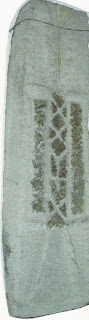
We can recognise in the English version of the Ing-Rune the human DNA Spiral; the rune-meaning 'son of' or 'offspring of' confirms this idea. The symbols on the White Stone of Ing (in this case the term 'white' has even greater significance) state - Gift of Ing, which is 'Fire' as shown by the Ken-Rune in the middle of Ing and Gyfu. But the shape of the carvings on the stone itself also seem to suggest a link to the DNA Spiral. (There is also a 'coincidence' in the name of the Inkas, originally Ingas I believe, which means 'descendant' or 'ancestor'.) The DNA or 'Genetic Code' is passed from generation to generation, and is thus the blood-link between the generations. This determines who we are.


Since the rune-stave itself is a double-X this underlines the meaning of 'gift', since this is indeed a 'gift' passed on to our children, and their children....But it is also the link between every individual and the First Man (Ask) created by Woden-Will-Weoh. As the Cycle of the Ages has moved downwards the former 'Pure Blood' or 'Sacred Blood' has been diluted over and over again, and this has accelerated in the past 1500 years or so, and today has gone at a breakneck speed. 

If we use the Vedic God Agni as a parallel to the English God Ingwe, Ingwe, like Agni is 'Born of Fire', and in particular 'Born of Friction-Fire' through the rubbing of two wooden sticks together - 

"Agni, (The Fire) is the Son incarnate of Savitri (Heavenly Father) conceived and born by the Virgin Maya and had the carpenter, Twasti, ('Maker of the Swastika') as his earthly father. In the Cave of the One of Both Sticks, which has the name 'The Mother', lives the Goddess Maya, the embodiment of Creative Powers, who gives birth to the Son under the influence of Vayu (The Spirit), the Breeze of the Wind, without which the Fire cannot be lit." 

Now, we cannot but equate this not only with Agni and thus Ingwe, but also of the Solar Krist, so we can here quote this same paragraph using different names -

"Krist (The Fire) is the Son incarnate of the Heavenly Father, conceived and born by the Virgin Mary and the carpenter, Joseph, as his earthly father. In the Cave of the One of Both Sticks (stable), which has the name 'The Mother' (The Womb), lives the Goddess Mary, the embodiment of Creative Powers, who gives birth to the Son under the influence of the Holy Spirit, without which the Fire cannot be lit." 

Indeed, in one telling section of the New Testament (will look up the exact part), John the Baptist states that he comes to 'Baptise with Water', whereas the Solar Krist comes to 'Baptise with Fire'. This tells us that Ingwe and the Solar Krist are one and the same - Kristianity existed long before the historical 'Jesus Christ'. Some scholars trace the origins of 'Christ' to Egypt, but there is here a hint that not was also an Archetypal Myth found in Aryan India. Not being too clued-up on Egyptian Mythology I can only hazard a guess that the Solar-Krist would be the equivalent to Horus the Son. If so, then this would encompass the Archetypal Myth of Hamlet which is not found in the New Testament version. 

The Vedic Vayu is 'The Wind' at one level, but at a deeper level this is the 'Vital Breath' (Ond) which is the Gift of Woden; Vayu seems to be a Vedic form of Woden. As we can see from the English word 'spirit' (based upon the Greek I believe) this relates to 'respire' and words like this, and thus to 'breath', and thus to 'Vital Breath'. Maybe Sleipnir is the Wind-Horse of Woden - the 'Great Breath' is Atem, AEthm, Atman, Odin, Woden, Wotan. 

"The first spark that came from the cavity (cave) of the sacrum of Maya (Womb of the Mother), by turning the Fire-Twirl Pramantha (Swastika) represents the birth of Agni. This spark is called 'The Child'."


The Fire-Twirl is here represented by the symbol of the Cweorth-Rune; since the VW Symbol when spun at a certain speed creates a Widdershins Thulean Swastika it is thus possible that when spun at a certain speed the Cweorth-Rune makes the same symbol - as would the figure of Rudra-Shiva -


Now, is it not also a massive 'coincidence' that this would also apply to the Long Man of Wilmington in East Sussex, England? This is the site where, on August 10th 1999, we buried eight bottles labelled 'Millennium Ale' containing a written ritual, on the labels of which was Old Father Time and a blond-haired, blue-eyed child. (*) The following day at 11.00am as the Sun darkened this ritual was performed at the Long Man. The Black Sun (Solar Eclipse) is said to 'resurrect' the 'King of the Angles' - i.e. Ingwe. Thus, through the Fire-Twirl Ingwe was 'resurrected' (reborn), ushering in the Age of Ing. 

(*) Yes, aware of the ritual said to have been performed by Guido von List this was done as a symbolic link to the German Awakening. The 'Sword of Hengest' passed from the 'Hun' to the Engel-Kin. 

When we consider the above we should note that the Vedic Vayu would more precisely be equated with Weoh (Ve), obviously an aspect of Woden. This is the Holy Spirit of the New Testament, the 'Breeze of the Wind', needed to ignite the Holy Fire (Agni-Ingwe-Krist). Three things are needed to kindle fire - Fuel, Air and Heat (FAH). The fuel is the wood by which the Nyd-Fire is kindled, the air is here symbolised by Woden-Weoh-Vayu, and the heat kindled is represented by Agni-Ingwe-Krist. 

We are here not speaking of the Birth of the Last Avatar, since this cannot take place until the 'Day-Break' of the Age of the Water-Jug. The period we entered around this time is that of The Hooded Man which is the Age of Ing - the transition period between the Age of Pisces and the Age of Aquarius. When we note that Sargon the First named himself the 'King of the Universe', ruling over Sumer in ancient times, it is clear that the Third Sargon will also take upon himself the same title (as did AEtla the Hun and Genghis Khan, the latter mentioned in the Sajaha Prophecies as the one 'not of our blood'), as the Last Avatar or the Man to Come. He will fulfil the role of The Second Coming as the Solar-Krist or White-Krist riding a White Horse and wielding the Word-Sword. In one sense The Hooded Man - like 'John the Baptist' - prepares the way for the Krist-Avatar; the Archetypal Myth once more takes form in the physical world. 


Rune of Destiny


"Use your destiny, don't fight it." - Guido von List

The Armanen Masters had a truly deep and profound knowledge and understanding of the Ancient Runes, one which anyone studying the runes should not overlook because this is not a 'traditional' runic system. List acquired his knowledge of the 18 runes through a mystical experience when he was temporarily blinded after a cataract operation, thus taking upon himself the Wotan Archetype to rediscover the Ancient Secrets. List, and other Armanen Masters after him, gave to each rune a short and simple catch-phrase. Here I am going to take a brief look at the above since it can be of great help to us today during the world's problems due to the World State Agenda.

"Use your destiny, don't fight it." The Nad-Rune is one of 'need' or 'necessity' and in itself it has the basic meaning of obstacles placed in front of us; in this sense it is a negative rune. But as with all runes it has two sides, and the other side is one of overcoming such obstacles; hence the meaning of 'need' or 'necessity' because it is these obstacles that force us to act in order to overcome them. Without obstacles in life we could not overcome our limitations as humans; this is the meaning of the words of the Aryan Krist - 'To him that overcometh will I give to eat of the Tree of Life'. 

We are witness to the way that most people today face any form of change, obstacle, or disaster; in the face of change and obstacles most people cannot do anything to overcome them, they are in a state of fear and terror that numbs their senses into being unable to act. This is clear from the pandemic 'raging' amongst us, which at this point is a virus (Omicron) which is no more than a mild flu in most cases. The 'proles' are unable to see through the lies and deceit, even when scientists and doctors are beginning to tell the truth of this - they prefer to listen to the lies and deceptions of the media, press and politicians (or perhaps better put those pushing from behind the scenes). 

I think that here we have a good example of the way two separate and different types of individuals react to problems and obstacles. The 'Ultimate Man' (Nietzsche's 'herd-animal') who is part of the collective masses, gives way to such problems by conforming to a clear tyrannical regime that cannot be seen as anything else but evil (we see this most clearly in such figures as the French President, Macron, and the way that in Australia there are 'concentration camps' ('quarantine camps' is used to hide the truth) where even young people have been confined). On the other hand the 'Overman' (or rather the 'Solitaries' who pave the way for the 'Overman') do not see this as a disaster or catastrophe, but as a means of overcoming our human limitations. Thus, it is the latter who use the advice of Guido von List in not fighting or denying their destiny, but using it as a means of overcoming their own limitations. 

The rune-stave is also symbolic of the 'Broken Ego', since it is the Is-Rune with a line breaking it into two parts. This is the Mystery of the Solar-Hero, the best known example being Siegmund who pulled the Sword out of the Sacred Oak, a mystery shown in this rune-stave. When the sword is pulled from the Sacred Oak what is left is the 'Ego' (I) made whole once more. In the famous operas of Richard Wagner, particularly his Ring Cycle we find some of these mysteries, where the sword wielded by Siegfried is named Nothung -'Sword of Need'. However, another rendering of the name Nothung would be the 'Need of Ing' which gives this a whole new level. 

In Norse Mythology the World Tree is the Ash-Tree - Iggdrasil; I have shown before that the Old English AEsc-Rune has a rune-poem that suggests that the Anglo-Saxons also saw this as an Ash-Tree, or at least some of them. I say 'some of them' because the most revered tree of the Anglo-Saxons was the Oak-Tree, which was not just seen as the tree of Thunor the Thunderer. It was the tree associated with Robin Hood, and thus with Woden; this is in fact confirmed when we recognise it as being associated with Herne the Hunter who is an aspect of Woden as the Wild-Hunter God. Like the other Germanic Tribes in Germania, the Anglo-Saxons held the Oak Tree to be the most sacred tree, and it is possible that the Iceni of East Anglia derived their name from the Oak Tree. 

Whether we use the symbolism of the Sword from the Oak-Tree or the Sword from the Stone makes no difference, for they both have the same basic meanings, including that of the 'Broken Ego' which is healed when the Sword is taken from the Tree or Stone. This symbolism also applies to the 'Broken Sword' which was re-forged by Sigurd-Siegfried in order to slay the Dragon. This too is made whole again. It is the Solar-Hero who wields the Broken Sword in order to slay the Dragon of Darkness and Chaos. The other important symbolism in both of these examples is that only the one who is rightfully 'king', who has the Divine Right to rule, can take the Sword from the Oak or Stone. This also applies to the re-forging of the Broken Sword, for only the 'Rightful Solar-King' is able to wield the powers of the Sword. Indeed, as we found in the figure of Aragorn (Lord of the Rings) it is only when he is given the Sword that he takes up the Divine Destiny allotted to him - which he tried to deny before, mainly because he did not see himself fit for such a task. 

In this case it is the Sword itself that represents the destiny of the Solar-Hero; we see this in the Saga of Beowulf where Hengest is given the Sacred Sword of AEtla the Hun - Hunlafing Hildeleoman - which passes the Wyrd of AEtla to Hengest, who thus becomes the 'King of Kings' and 'Lord of 'Lords', taking up his destiny of 'World-Ruler' (werold-raedan). I recall somewhere of a similar example in more modern times when a Sword forged in Solingen was passed to a similar type of 'World-Ruler'. The Spear of Destiny has a similar meaning (strangely enough the Spear is broken into two pieces). 


What we need to understand about the examples I have given here is that these conform to an Archetypal Myth and that this is how we can recognise certain famous figures in history as living that Archetypal Myth and we can better understand who they are and their role in life. Hengest is the Geist of Ing ('Spirit of Ing') and it was his role, at that particular time in history, to lead the English Tribes here to the British Isles to create the English Folk-Nation which would arise in later times. It is also important to note that Hengest was one of the Divine Twins and what we know of him comforts to the archetypal pattern of such figures as Romulus, AEtla and Genghis Khan, all of whom slew their brother or half-brother, though this does not appear in the Myth of Hengest. 

In this respect the events around August 11th 1999 take on an even greater significance; this was the conception of the Age of Ing. When the Black Sun 'resurrected' the 'King of the Angles' (Ingwe) this tells us that in our time the Spirit of Ingwe has been reborn to once more lead the English Folk in their True Destiny. In the Robin of Sherwood TV series of the 1980s we find that it is the Sword Albion (Seventh Sword of Wayland) which is the key to the Destiny of The Hooded Man (Robin Hood), and is passed from Ailric of Loxley (we have to assume this) to Robin of Loxley, and then to Robert of Huntingdon. This is also true of the Bow and Arrow used by The Hooded Man; we have also the symbolism of Herne's Arrow woven into the tale. (The Bow and Arrow is clearly a much earlier symbolism connected to Woden-Herne as the 'One-Eyed Hunter-God'. This is not clear in regard to the Norse Odin, though this may be seen in the figure of 'Arrow-Od' who seems to be a kind of 'Wild Man of the Woods'.) 

So, the massive problems that we face today should not be seen as something to despair about, nor seen in the negative light that the Forces of Darkness try to create. What is happening should be seen as an obstacle that we need to overcome, a problem that has to be solved. In this regard the Nyd-Rune is also about the problem, but it also tells us that the solution to that problem lies within the same rune. Basically, the solution that stands out clearly is that these obstacles must be seen as the means to overcome our human limitations, to fulfil our Divine Destiny, and as a means to fulfil the evolutionary-drive towards the Sixth Root Race - the Sun-Man (Sonnenmensch). 

Saturday, 25 September 2021

A-L-U The Magical Force

This runic stave has been looked at many times, but as far as I can see no-one has actually come to any conclusion as to what it means - including myself, of course. We use it as a Runic Exercise but that is obviously not what it was first designed for, since it appears mostly on funeral urns here in England, sometimes together with the fylfot-swastika. But we seem to have nothing about how it was used, why it was used, and the meaning of the formula. 

Firstly, we should perhaps do as the Armanen Adepts did, and that is to break it down into the individual runes and their meanings -

AEsc/Ansuz - The Ancestral Rune. Looking at this from the English perspective the AEsc-Rune is the Ancestral Rune, whilst the Os-Rune is the Rune of Woden as the Ancestral God, though they are both linked together. 

Lagu - A body of water, a lake; also meaning 'law' or 'to lay down'. We know that Woden seems to have had the role of The Ferryman possibly ferrying the dead over the 'Waters', and we have the theme of King Arthur being ferried over the lake to Avalon. Here we do have an association with death.

Ur - The Primal Ox, but here maybe more likely the association is with origins, maybe a return to one's origins. 

Well, that does not seem to have got us any further, but who knows? Next I would like to look at the root-words connected to the word ALU -

*alu- - in words related to sorcery, magic, possession and intoxication. This is backed up by the meanings of various words that contain alu in many different cultures of Indo-European origin. Certainly the word is connected to the English ale, hence the link with intoxication. 

*al- - Beyond

       - To wander.

       - To grow or nourish.

       - To grind or to mill.

       - All.

The word hallucination stems from this same root, and the earlier meaning (before it was distorted) was centred around the 'wandering' of the mind rather than seeing something that is not there. That the root-sound forms the basis of our word hallucination certainly suggests that the two roots above are linked, though maybe not all of the meanings. The term 'beyond' again suggests death and the afterlife. 

Moving now to a story that I have told before in one of my books, hoping this will not bore those who are familiar with it. Some years ago when my kids were small my ex-wife and I took them over to Wayland's Smithy which is now in Oxfordshire, but was in Wiltshire. We set up a tent by the long-barrow and I lit a small fire in front of us whilst filling a mead-horn with mead from a bottle. We were drinking drafts of the mead when a couple appeared from the gateway of the Smithy, the man with a t-shirt printed with a pentagram. It turned out that his partner owned a 'New Age Shop' in Wantage which is not far from the area we were in. Out of politeness I asked if they wished to drink the mead, which it seems they had never tried. She accepted and took the mead-horn from me, asking what the letters 'A-L-U' meant, burned into the leather band around the horn. I said - 'ALU' to which she seemed rather shocked.

She mentioned that she was a medium, and it turned out that a week before this they had visited the barrow and there she saw a tall, blond warrior-figure with plaited hair, and carrying a spear and shield. This warrior stood before them and uttered 'ALU - ALU - ALU'. Now, this type of synchronicity should not be lightly dismissed, since we need to consider that the figure said this, and then a week later my family visited the site with a mead-horn marked with the term ALU. This is a 'meaningful coincidence' and as such should be taken notice of, since it can sometimes be seen as a 'message'. 

We have here a 'warrior', but obviously one that does not live here in this world, but in the Realm of the Dead or Realm of the Ancestors. We are here back to the meaning of the first rune - AEsc/Ansuz. Of course, this could have been the god Woden as the Ancestral God, though this guise is not usually encountered; we should not dismiss this out of hand though. There could, of course, also be a link to Weland the Smith since this is where he is said to dwell. 

Let us now turn to another aspect of this subject, and that is the rune-formula also found in connection with a funeral urn - ALUGOD - which has the Fylfot-Swastika with it. ALUGOD could well mean 'God of Intoxication', but it could also mean 'ALL-GOD" or perhaps 'All-Father'. I have mentioned in previous posts and in one of my books how the term ILU means 'God' or 'Light', from which we get the names 'Babel' ('Gateway to God' or 'Gateway to Light') and 'Babylon' (the same meaning). ILU and ALU could thus be much the same in their meaning, though the cultures are well apart. 

This runic-stave has been found on various bracteates including the new 'Jutland Hoard', and here it seems associated with 'WODIN' and also having the Fylfot-Swastika in the symbolism, as well as a horse. One figure has plaited hair, and is riding a horse; before him is the Fylfot-Swastika. One important feature here is that the horse has horns shaped much like the Gold Torcs used in Europe, and this horned-symbolism has always been associated with the divine. The horns may well be used to 'break through' into the Otherworld. 

There is yet another aspect we should not overlook, and that is how the Fylfot is associated with the 'Foal's Foot' or 'Fool's Foot' which we find on the Merseburg Charms. Here the steed is the Foal of Pol (Fol = Baeldaeg) whose legs are 'broken', thus forming the Swastika with four 'broken' legs. It is significant that it is the god Woden who can heal the 'broken' legs, and thus return the symbolism to that of the 'Sun-Wheel', with the 'Ring of Baeldaeg' returned to the symbolism. This ring Woden placed upon Baeldaegs's funeral pyre, that it would be there for him in Odainacre. In this respect, it would seem, the Fylfot-Swastika is symbolic of Baeldaeg in the Underworld (Odainsacre). 

All of this points to a connection with the Underworld/Otherworld or the 'Inner Earth' (Serrano); the use of it on funeral urns points to a connection with the dead. This may also go for the Fylfot-Swastika and its links to Baeldaeg who dwells in Odainsacre until after Ragnarok. 


In an article on Thule posted on the Inglinga Blog recently I mentioned that the Long Man of Wilmington could represent the 'Gateway to Thule', since it faced north and can certainly be seen as a 'gateway' or 'portal' into another world, guarded by the Waendal. It is important to note the use of the name 'Pol' for Baeldaeg in the Old Saxon Merseburg Charm, since the Long Man is some 2-3 miles from a place called 'Polegate', a name rendered 'Pool Gate' but which could just as well have been 'Pol's Gate' since the name 'Pol' crops up in various English place-names. If so we do have some clues here -

  • The Long Man is shaped as the Cweorth-Rune which is the 'Funeral Fire'; since these were found on funeral urns this would be the cremated ashes inside. 
  • The Cweorth-Rune, as Hamasson once pointed out to me, may well create a Fylfot-Swastika when spun around at a certain speed. This has been shown to be so of the VW symbolism on a hub-cap. 
  • There is a White Horse to the west of the hill-figure, though a late Nineteenth Century carving; maybe there was one more ancient that this was carved upon? 
  • On top of the Long Man a 'Golden Knight' is said to be buried, again the link with the burial and the dead. 
The one thing as yet not covered is the version found on a burial urn in Norfolk, one containing the formula ALU-ULA. This one certainly suggests a connection between two worlds, since the 'otherworld' is said to be a 'mirror-image' of the physical world, where everything is the other way around. Here we have that exact formula in ALU - ULA. 

The basis of the Germanic Mannerbund was that of an age-set based on the young warrior and his relationship to The Ancestors. There could, of course, be some connection between the term alu and that of hallow and this we can associate with 'All-Hallows Eve' (Halloween) which is clearly associated with the Ancestors (the dead) and with the link between the living and the dead at this time of the year. This is clearly linked to the ancient Germanic Mannerbund where the living young warrior becomes the dead Ancestor, or maybe put better the Ancestors 'possess' these living young warriors. In which case we have a clear link to the Root *alu- and its meaning of 'possession'. 

Maybe this is a magical force that is clearly able to pass from one world to another world, from one being to another being, and perhaps this is why this symbolism was marked on the funeral urn of one of the dead. This allowed the dead warrior to pass back into the physical realm to 'possess' his counterpart in this world, just as the ALUGOD Woden 'possesses' his initiates. We can also note that on the bracteates the Horse-God is connected to the ALU Formula and to the Fylfot-Swastika, the horse being a Shamanic-Horse that can pass between the two worlds, as Woden does on Sleipnir. We find Hermod (The Messenger) using Woden's Steed to pass from the World of the Gods into the World of the Dead, there to try to free the god Baeldaeg. 

Where we find the 'horns' on the Shamanic Steed, as stated this suggests that these 'break through' the veil between the worlds, and in one bracteate this is next to the Fylfot-Swastika which may be symbolic of Baeldaeg in the Underworld. There is just a possibility here that since the death of Baeldaeg was the key point in the decline and decay of the Folk and the Gods then at one level the Black Swastika represents the Black Sun which has been 'occulted' to keep it free of this decay and death, just as Baeldaeg and the Asmegir are free of this too.


The Black Sun is made up of 12 reversed Sig-Runes, but also of 3 Fylfot-Swastikas; unlike the 'static' Swastika Symbol' this suggests movement and turning since it suggests a wheel turning upon its axis. What we have here clearly suggests that at this stage of the Cycle of the Ages the Black Sun has been set into motion and its power has started to wax stronger once more. 


This photo of the Black Sun as a crop-formation on 8th August 2008 (8-8-8), has been slightly altered, something that we should take as being important. The 'arms' of one of the three swastikas seems to be 'breaking through' the Second Ring, as if breaking through water (it seems to be refracted). The four 'dots' (as I have mentioned in an earlier blog) may represent the Four Beasts and thus the change of world-age and the end of one Cosmic Cycle. If this is so then this hints that the growing power of the Black Sun coincides with the change in world-age. There is also a link with the Number 8 not only in the dating of the formation, but in the symbolism here where the four 'dots' are each in a semi-circle to which two Sig-Runes are joined - making 8 in all. There seems to be some kind of 'sequence' around 2 - 4 - 8 based upon doubling each number, and not on 2 - 4 - 6 - 8 on adding 2 to the last number; the Number 6 is thus left out. The emphasis here is upon moving quicker through the doubling of the numbers - maybe time speeding up? Doubling is obviously multiplying by 2, and the 4 'dots' here create an X-Cross, symbol of 'multiplication'. 

The power of the Black Sun is growing, even though these times are controlled by the Forces of Darkness and Chaos. This may yet not seem apparent, since this control is almost total, but there are still signs that there is a growing Power of Light even in this almost-total darkness. The Black Sun is the Spiritual Sun which can be felt in the Igneous Blood of those who are faithful to the 'Spirit of Man'. This emanates a Spiritual Light that aids the struggle against the Dark Forces, and is the connection between our world and the otherworld, and also with the Origin and Destiny of our Folk. 

We can expect the power of the Golden Sun to be weakening now, which is surely is when we consider the world around us today. The Golden Sun seems to be linked to the rational and intellectual mind, which has no doubt developed under the Golden Sun. The Black Sun works through a different level of consciousness, a more spiritual level at a higher vibration. Here we should look back at the ALU-ULA runic formula since if this represents a shift between two worlds, a shift in consciousness and vibratory levels, then this parallels the shift between the Golden Sun and the Black Sun. 


The colour used of the Swastika Symbol is here black, suggesting the Black Sun since this is said to be a 'solar symbol'. When we hear the words 'the Sun turns black' in different sources of prophecy this can be seen as a Solar Eclipse, as that of August 11th 1999. But this could also be a secret reference to the Resurrection of the Black Sun, which seems to be hinted at in the Prophecies of Nostradamus related to the Solar Eclipse of August 1999, where this is the 'great King of Terror' in the sky. This brings back to life (resurrects) the 'King of the Angles' - Ingwe. We do here have a link to Ingwe as well as to Baeldaeg, and the Swastika being linked to the Vedic Agni it is thus also linked to Ingwe - the Fire-God. 


We seem to have gone off track here, but these points are important in some way and thus put forward for more study. Ingwe (Agni) is the 'Fire-in-Water', the 'sap' in the plants, and the 'blood' in animals and man. He was first 'hidden' from man, dwelling in the Waters (of the Lower-World), and only 'kindled' into life through the Friction-Fire. Woden decreed that his Chosen Warriors be cremated and then buried in a mound, this 'cleansing-fire' purifying them and transforming them in order to enter the World of the Gods. 

In one sense we could see the Resurrection of the Black Sun as the Resurrection of Thule, since this would have been the Sun of Thule. There is also a synchronicity here in that, as I have shown in the Inglinga Blog article, the word thyle can mean 'simpleton' or 'fool' and here we have the Fool's Foot symbol associated with Woden - The Hooded One. All of the associations with the dead, with the Ancestors, and with the Ancestral God (Woden) suggest that both the Swastika and the ALU-ULA formula are connected to the passing between the world of the living and the world of the dead, and that maybe (?) the Fylfot-Swastika is symbolic of the Black Sun or Hidden Sun of Midnight, which shines above the Midnight Mountain in the Land of Thule.

There is just one more thing, and that is the link between Mount Kailas in India (Swastika Mountain) and the god Rudra-Shiva who has parallels to Woden, and is famous for the Fire-Dance of Destruction. The god Shiva is shown in the stance of the Cweorth-Rune - the Fire-Twirl. ALU can thus be seen as a Magical Force that moves between the world of the living and the world of the dead, and this is connected to Woden as the God of the Dead. We find Rudra-Shiva linked to the type of Mannerbund age-set that existed in ancient times. 

These are just ideas thrown up at this time, and I hope they may form the basic ideas around discovering the secret of ALU and the Fylfot-Swastika symbolism, and their association with the World of the Dead, and the travel between these worlds associated with the symbols. Maybe the form of ALU is connected to 'hallow' and thus to the Magical Force called Heil which was invoked by the raising of the right arm, open-handed into the air. Thence we can see that this could have been a way to bring the dead hero back to his Heildom on death, that he may enter the World of the Gods. This would be a return to the original state (UR) since this world is now so defective. Maybe this is the next theme to pursue in a later post.