Ar-Kan Rune-Lag

Ar-Kan Rune-Lag

Thursday, 18 September 2014

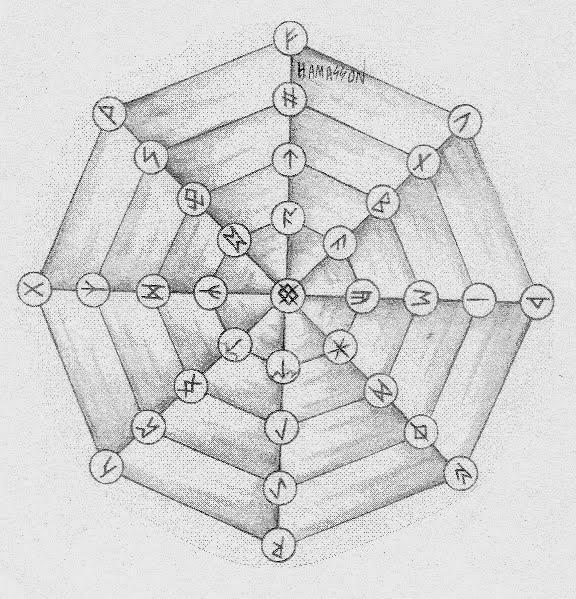
The Rune-Web

 
The Rune-Web was drawn by Hamasson of Woden's Folk some years ago, for use in our magazines. It is perhaps time that we made a deeper study of this, since it is an important image for Rune-Workers. I have to add that this is just one way that the runes can be set, and there are many ways used by WF - each with its own unique importance. Of course, this is a new image, and not (as far as we know) found in any 'tradition' - but the runes evolve!
 
At the Sacred Centre is the Gar-Rune which is the Spear of Woden - Gungnir ('Gift of Ing'). This represents the 'pole' or 'central axis' from which all runes emerge. It would have been this point, the Sacred Centre, that Woden would have had to reach (through a 'mystical death' and 'resurrection') in order to rediscover the runes for us.
 

The photo above is reproduced from an image used by David Icke, and shows the area where the Egyptians recognised as being the seat of the Third Eye. In diagrams of the proposed Order Castle in Wewelsburg, Germany we see that a spear enters the proposed central area, aimed at this very point. It seems plainly obvious that the nature of the new Order Castle was to open the third eye of the Initiates. The Eye of Horus thus seems to depict the Third Eye - what we could call the Eye of the Hero. This is a physical centre that represents a Spiritual Centre, and this point is important.
 
In Wewelsburg 1933 - 1945 A Cult and Terror Centre of the SS we find the plans for the extension of the Wewelsburg Castle, with the semi-circle and 'spear' which penetrates in alignment with the North Tower. It is impossible to miss the shape of the Spear entering the Gral. In Tantric Lore the aim is to unite the Serpent Goddess (Shakti) with the god Shiva, and thus open the Third Eye. Thus the Gral (at one level) refers to the uniting of the Hero-Valkyrie opening the Third Eye. Since this project was meant to be the Centre of the World it would seem that the opening of the Third Eye was a 'world project'.
 
There are 32 more runes scattered orderly around the Rune-Web (8 x 4) which makes for a very orderly pattern of 4 x first rune, 4 x second rune, etc. starting from the outside. The 33 - rune English rune-row is used. Rather than the runes being in straight eights, they are placed in a cyclic form moving clockwise around the web, and starting at the top with the next eight. These are the rune-names used within the Ar-Kan Rune-Lag -
 
Feoh
Ur
Thorn
Os
Rad
Ken
Gyfu
Wyn
 
Haegl
Nyd
Is
Ger
Eoh
Peorth
Eolhs
Sigel
 
Tir
Beorc
Eh
Mann
Lagu
Ing
Daeg
Edel
 
Ac
Aesc
Yr
Ior
Ear
Cweord
Calc
Stan
 
 
Gar
 
There are variations to the certain runes, and different names are used too; these are the main runes that have variants -
 
Ken
Yr
Cweorth
Stan
Gar
 
Different rune-names can be used for runic-gealdor since certain runes have very different meanings (on the surface), for example -
 
Sigel - The Sun, Solar Power, Solar Force.
Sowilo - the Soul, shape-shifting, soul-travel.
 
We can see that the runes are far from static and must be used in different ways to produce certain results. There are certain simple rules to rune-magic -
 
1. Visualisation of the Rune.
 
2. Gealdor - Sounding of the Rune.
 
3. Will - Sending of the Rune through the Force of Will.
 
Perhaps the most important thing is - intent. Without this no result can ever be expected, and doing rune-chanting for the sake of rune-chanting can be dangerous. Some occultists warn not to use 'lust for result' but this does not mean what I have said, for there has to be something that the work is undertaken, and this has to be a result from the working. What these people mean is not to dwell on the result, but to use the Force of Will to send the runic-power, and not dwell on it after.
 
We have used runic-gealdor-visualisation with groups of people at Folk-Moots, but this has been used in a way to achieve results within the group - lifting the 'spirit' of the group, which it certainly does. But for other runic gealdor the better way is to use a specific group trained in magical arts, since it takes years to do so and more experience is needed so that dangerous forces are not invoked - or the work rebounds back, which is certainly true of any form of negative magic. This is why it is always wise to use a positive magic that causes a change.
 

We have used the Nine Glory-Twigs in teaching and this is a Mother Rune out of which all 33 runes are obtained. Once again, Woden discovered the runes, and he would have lifted them out of the Mother Rune or Primal Pattern. It can be no coincidence that a Secret Rune-Row given to a Woden Initiate a few years ago also fits into the above pattern. We can only assume from this that since these are not 'traditional runes' (like the Armanen Runes) the pattern contains an infinite number of rune-shapes that can be 'discovered' by future rune-workers. The centre of this is once again the Gar-Rune.
 
Now are Har's sayings   spoken in Har's Hall,
of help to the sons of men,
of harm to the sons of the Jotun....
 
The 'Sayings of Har' 165.
 
Here we are told clearly that the runes were discovered by Woden for his own Northern Folk that they may aid them, but they would cause harm to the Jotun. The name of Woden here 'Har' is said to mean 'High One' (Sturlasson) but it is rooted in the same as hari/heri and related to the Hero-God - God of the Mannerbunde.


Monday, 28 July 2014

The Berserker

The usual meaning of the phrase 'to go berserk' is that of someone who loses his temper and is not in control of himself. This stems from the idea that the Viking Berserker (where the phrase stems from) fights in a state where he is not in control of himself. This idea is enforced by the idea that this type of warrior fought under the influence of the Amanita Muscaria or Fly Agaric mushroom - the red-capped mushroom found under the birch or pine tree usually. It is certainly true that the German name of this mushroom contains the idea of the Berserker. Whether this is evidence to prove this or not is open to question.


But there is reason to doubt these ideas, since anyone who is not in control of himself would hardly be in a position to hold up in battle as well as someone who is in complete control and is calm and aware of what is going on. In any case the Amanita Muscaria seems to enhance awareness and focus consciousness, and not take the individual into a state of anger and loss of control. We have this quote from the famous film-star and martial artist, Chuck Norris - 'Men are like steel, if they lose their temper they lose their worth'. It is never in the interest of any warrior to lose control through losing his temper. The Berserkers were often bodyguard to a king, so their role would be one of protection, where calm and awareness would be essential.
 
It is more likely that a controlled rage was the key to the secret of the Berserker, a rage that is deliberately invoked by various means -
 
1. Perhaps by working on a punch-bag or the like which is hit over and over again as a rage is built up.
 
2. This could be enhanced by visualising someone that one hates to such an extent that anger and rage is built up through 'hitting' this person over and over again. Here a good deal of self-control would be necessary so as not to lose control altogether.
 
3. The repetition of this type of exercise would result in being to invoke such a state at will, without the need to go through the whole process first.


All this, of course, is mere guesswork but it does seem to make more sense than seeing the Viking Berserker as some form of 'violent thug', which is how this figure is often portrayed. In any form of Martial Arts the individual goes through a strict training process, and through set forms and movements, all of which enhance his power and ability to fight. The Viking Warrior would also have had some form of Martial Arts training, since this is all part of the process of building the warrior. It would perhaps be true to say that the young warrior may have had bouts of temper and loss of self-control (as in the tale of Egil Skallagrimsson) but this would not be true of the more experienced, mature warrior who would have created the Calm Centre and thus acted like the Eye of the Storm. 


Wednesday, 16 July 2014

Evolution of the Runes

The runes are not static and unchanging, and we should not forget that Woden did not create the runes (which already existed), for he rediscovered them through undergoing a shamanic initiation. We have meanings for the runes passed down to us, but they are heavily influenced by Christianity, coming to us during the early parts of the growing influence of the Judaeo-Christian Church. It would certainly be highly unlikely that the magical application of the runes would come down to us during this time, since this is where the Christian Church stamped down hard upon. What we have left is a set of rune-poems from different areas of the Northlands which are Christian in form and which have very mundane and everyday meanings.
 
If we look at the Greek and Hebrew alphabets we find that the letters also have names, again very mundane in meaning, but which also have a number and a hidden meaning which can be found in the Mystery Tradition of each particular culture. We can safely assume that the runes have a similar status which has been almost lost to us due to centuries of suppression. If we reject the idea that certain individuals are able to contact the inner meanings of the runes through intuition, meditation and other rune-work, then these meanings would be completely lost forever. Guido von List showed how these inner meanings could come to light again, and since then others have followed on and the runes are again evolving within the Folk-Consciousness. There is growing proof that the runes lie deep in the consciousness of the Folk, and that certain individuals can tap into this consciousness to gain new insights into their meanings.
 
The process of evolution is not done by one single individual, but by many different individuals working perhaps as facets of the Woden-Consciousness, rediscovering the runes as Woden did on the Wolf-Tree. As one individual finds new meanings others can see further insights, and the process goes on and on - all within the growing movement of Wodenism/Wotanism/Odinism. The runes are thus not stuck in a bygone era of time, the time of the 'Anglo-Saxons' or the 'Vikings'; if this were so they would be of no use to us today.
 
We have ample proof of the changing nature of the rune-meanings, so one example should suffice for this post. The meaning of the Feoh-Rune is 'cattle', pretty mundane and down-to-earth. What we need to consider is the essence of the meaning, and not just the form, for the runes are symbols. Cattle was the original measure of wealth within a tribe, which (as the different rune-meanings show us) altered by the Viking era into gold. Both were, to an extent, a measure of exchange between individuals or groups. The essence of this rune is thus exchange - something passed from one to another. From this we get another measure of exchange - the 'fee', a word that derives from the rune-name Feoh. From the original means of barter we have gold or silver as a means of paying for an exchange, from which came 'money' and today 'credit' on a grand scale. The system has gradually degenerated until money can be made from money, and indeed wealth can be made from nothing in a system of credit or 'usury' (money-lending with interest). The idea of 'usury' broke the basic idea of exchange since nothing is actually passed from one to another, the only meaning being that of gain without any work involved at all.
 
But we should not stop at physical meanings for each rune, since they have inner meanings that are not apparent until the symbol is studied and meditated upon. The first letter of the Hebrew Alphabet is Aleph which means 'cattle' - coincidence? The Greek Alpha has a similar sound too, and is also the first letter of their alphabet. As stated before, both in Hebrew and Greek the letters also have hidden meanings that were known only to a few esoteric workers in each tradition. This would also be the case with the runes. So we cannot stop at the mundane meaning of 'cattle' or of 'gold'. It would seem clear from the child's tale of Jack & the Beanstalk - based upon this Feoh-Rune - that this represents a Solar Initiation in which Jack gains the Solar Knowledge through undergoing a series of trials, stealing the knowledge from an 'ogre' - or rather taking it back since at the end we find that the 'ogre' had stolen it from Jack's father. As well as this being an Initiation Rite it is also a dim remembrance of the Aryan Myth in which the treasure (cattle or gold) is stolen from the Arya by the Jotun ('ogre' in this case) and regained by the Sun-Hero.
 
Nowhere in any of the rune-poems do we find reference to a Gealdor - Fe-Fi-Fo-Fum - which can be found in this tale. But we do find reference to 'gold' which can also be found in the tale of Jack & the Beanstalk - golden hen, gold coins, and golden harp - and gold has always been as Solar Symbol. From the mundane meaning of 'cattle' and 'gold' we have come to an inner meaning associated with Solar Knowledge. Horns have always been associated with the divine and would seem to represent a penetration into other worlds of being - a 'breaking through'.


Here we find a Boar with 'tusks' which have the same symbolic meaning as 'horns', and in the figure below (from the Horns of Gallehus) we have a horned figure -


This figure, on a runic horn, contradicts the idea that a Horned God was never part of the Northern Tradition, as does the die-cast shown below (from Sweden) -


In this one we can see clearly that the 'horns' of the 'dancing-warrior' are clearly symbolic, ending in bird's heads. There are also 'Solar-Horns' and 'Lunar-Horns' in a state of balance. A close-up of the die-cast shows the right-eye missing which could be a flaw, but there are also other figures with the right (or left in some cases) eye missing. This could thus be Woden - the One-Eyed Hunter-God. Woden is the most ancient Wolf-God and here we see an Ulfhednar Warrior.
 
The bull ('cattle') was in some ancient cultures symbolic of the Sun and thus of Solar-Power. This links it directly to the 'gold' of the other rune-poems, and thus the 'wealth' is really that of the Solar Knowledge of the Arya. The term Arya actually stems from the Aryan Root *ar- which means 'to move' (the Sun's perceived movement across the skies) but also 'to plough' which suggests the work done by oxen ('cattle'). The very basis of the keys to the Aryan Mysteries lies in the theft of the Solar Knowledge and its retrieval by the Solar Hero. This is thus the Primal Rune which contains this Primal Knowledge which is at the core of our struggle. We can see the symbolism clearly in Jack and the Beanstalk where the 'ogre' steals the gold objects from Jack's father, and Jack goes through a series of trials in order to regain what is rightly his.
 
In the Persian (Iranian-Aryan) version Kau Khusrau is the rightful owner of the Hvareno but the Turanian ruler steals the 'Glory' which belongs to the Aryan Nations and it is Kau Khusrau who has to regain it. We find this reflected in the Norse tale where Loki steals the Brosingamen Necklace from the goddess Freya which is regained by Heimdall (Hama) after a series of trials. We should reflect that the rune-name Feoh has roots in words meaning 'fire' and 'light' and that we have here Fire (Hama) pitched against Fire (Loki). Indeed, the Necklace of Fire is regained from the element of Water - from a lake in both cases. This is the secret of Fire from Water and the Great Deep. The Glory of Light is associated with the Sun and of Solar Kingship.
 
The Glory of Light is held by the goddess named Ardvi Sura Anahita just as the Necklace of Fire (Brosingamen) is held by the goddess Freya. The Feoh-Rune is not only the 'Father-Rune' but is also connected to the goddess Freya and to the Waene-Gods. The Waene are associated with the planet Venus (The Morning Star & Evening Star) which is the herald of the Sun, the Dawn, and the Twilight Hour.
 
We have seen here, just by widening the view of one rune we can find numerous new meanings and new interpretations - all individual interpretations but nonetheless valid ones that aid our knowledge. No matter how many thousands of ancient books, documents, and knowledge are destroyed at a physical level these symbols remain in the Blood Memory of our Folk and can be brought to the surface by those who work at an esoteric level. The runes are ever-changing and ever-evolving just as we are evolving.


Sunday, 15 June 2014

Wodenic Ritual Regalia

This post is going to show you various pieces of regalia used by Woden's Folk in its ritual work. Here we shall show the photos but make comments only where these are felt to be important.
 

These are fylfot-swastikas burnt onto the Ritual Hammer of Thunor used at all WF Rites in the past, and made from oak from a 'blasted oak' (an oak-tree blasted by lightning).


The Stone of At-al-land which is a magical stone thrust up from within the earth in a massive catastrophe that hit the Northern Continent of At-al-land some 7,000 years ago. This piece comes from the Moray Firth in the Scottish Highlands which has a major fault-line running through it and cutting Scotland in half at this point. This Magical Stone is part of a much larger piece which is kept in a secret location in England. The small stone is used for all Wodenic Profession and Initiation. The stone was found at a place called The Fairy Glen which is a spot at which an Odinist Magician and I performed an Alf-Blot and a shimmering blue figure appeared before me as I meditated at the spot after the blot. This was the area in which I undertook an Odinic Initiation into the Circle of Ostara where a blood-rite was used (spilling my own blood) and two sea-eagles swooped down over me as this was done.


This is the Ritual Drum that I use for Woden's Folk rituals and for magical workings. The drum has the Saxon Irminsul and various runic staves painted onto the surface. The outside is covered by deer-hide and the drumstick used has a wolf-skin cover to 'mute' the sound.


Marked in runes on the stave is the name WULF INGESSUNU which is one of my Wodenic Names. The drum-stave was made myself and the runes burnt-cut into it.


The Ritual Mead-Horn with silver finish to the drinking-piece and two leather bands, one with the runic formula ALU-ULA.


Small Ritual Blowing-Horn.


A Balder-Knife and Horn Steel-Striker (Lapland) used for lighting the Ritual Fire through Need-Fire (the Horn-Steel being held upright and the Ritual Knife at an angle, thus making the Nyd-Rune; the strike is through 'friction' and thus is seen as Friction-Fire (Need-Fire).


Wolf-Skin worn at rituals by the Wulfinga - Sons of the Wulf. Many of those within WF have taken on names with 'wulf' within it and this has been significant in view of the nature of our Order.


Above is the Sunwheel Arm-Band worn by the Folk-Warder at the Wodenic Rites, the Torc of Honour bearing the Thule Swastika, and the Black Sun Headband worn at our rites.


This is the Ritual Seax and Black Sun symbol used as a cover for the knife; these are also used in certain rituals.


The blowing of the horn is meant to awaken the Gods, but I also use a whistle for some of the magical work, this being easier to carry around in the pocket. The whistle does the same symbolic act as the horn, and is made of horn as well. This one was made by an old friend and Odinist Magician who was in the Odinic Rite for many years.
 
 
There will be further posts on ritual regalia and magical regalia, and also on rune-staffs that I have made and use. 


Rune-Craeft

This post is going to outline how to make runic wands, runes, and other ritual regalia used within the Woden Folk-Religion. Some of the stuff shown here is used by Woden's Folk in their rituals. It is important to try to make the stuff yourself, using the correct tools and above all hallowing each object ritually to 'charge' it with Vital Energy. Firstly, I am going to give some advice on how to make  ritual objects yourself -
 
1. Use hand-tools that are solely for this work.
 
2. Never use any form of electric tools.
 
3. For runes, runic wands etc. I have used Rowan Wood, since 'rowan' is 'rune' and since Tacitus tells us that some Germanic Tribes used 'fruit-bearing trees' as wood for their oracle-staves this fits with this perfectly. But there is no need to become dogmatic as any wood that suits your purpose can be used.
 
4. Red Ochre is used to 'redden' the runes, and I have always used a 'prick' of my own blood to 'charge' the runes with my own Life-Force. It is essential to 'charge' them for your own use.
 
5. Linseed Oil is used to protect the wood after finishing, and beeswax polish to finish off the product. Linseed oil is made from flax which is sacred to the goddess Freya.
 
Details of how some of these ritual objects are made can be found on the Woden's Folk website, but here I am going to outline some more details that may be relevant and helpful to your work.
 

One of the tools that you will need is a good sharp knife that is uses solely for this work; I use the above knife which is sharp and used to finish the product, and to 'sharpen' the runic staves which are burnt in rather than carved (saves less blood-spilling, but if you are handy at carving such small and delicate stuff carving would be ideal). I have two knives, the other one being similar to this one but slightly smaller.
 
24-Rune Futhark -


These rune-staves are about 1 1/2 inches high, 3/4 inch wide and about 1/4 inch thick and have been burnt, carved to finish, stained with Red Ochre/Blood and protected with linseed oil and beeswax. This is the first rune-set that I had attempted and came out very well. The edges have been chamfered using the knife which gives them a 'rough' finish. Note that I have not tried to make each rune uniform and the same dimensions because this makes them look a bit more 'authentic' looking.


24-Rune Futhark -


This set is very much smaller than the first set, being about 3/4 inch long, 1/2 inch high and 3/8 inch thick, this time cut from round pieces of rowan wood, split down the middle, leaving one smooth side and one rounded side, the runes being carved on the smooth side, of course. Note the small leather pouch that they are kept in (get these from any leather store or re-enactment fair) and the god-head on the leather closure-thong.


33-Rune Futhork -


This is an entirely different version of a rune-set, being made up of small pieces of rowan wood cut across the section, leaving on the bark if you wish, and then having the runes burnt on the cross-section. Being only about 1/2 across or less these are a bit harder to get the runes onto, but easier to cut and make than the larger ones. (The stone above it has an 'eye' naturally within itself, and thus here represents the Eye of Woden.
 
 
33-Rune Futhork -


Again we have a different type of rune-stave, in this case 33 staves cut in lengths of about 4 inches each with the bark left on. Each end is shaved smooth and the runes burnt-cut into this section. These can be used for an entirely different form of divination, in which the staves are thrown onto a cloth and the stave-shapes as well as the runes themselves taken into account in a reading. These rune-staves were made from hazel rather than rowan, hazel being a sacred wood for water-divining.
 
 
Nine Glory-Twigs -


From this simple pattern all 33 of the runes of the Ar-Kan Rune-Lag can be found. The Glory-Twigs are made from rowan wood cut 9 inches long (the 'Sacred 9') and are carefully placed in this position to make up the 'Mother Rune'. It should be noted that the 33 runes are all found within this shape, but there are also an infinite number of shapes contained within it, so the runic staves are almost endless. The 33 rune-row is the longest that we know of, but there are more recorded runes that are not in any rune-row.
 
 
33-Rune Wand -


This Runic Wand has the 33-runes burnt-cut into the rowan stave along two edges, made up of four sections of eight (32) with the Gar-Rune burnt-cut into one end as the Sacred Centre or Cosmic Axis. A silver Fylfot-Ring has been pushed onto the stave to finish, and a piece of 'bluestone' hung from one end. The wand and nine glory-twigs are shown below -


These two provide a unique Ar-Kan Rune-Lag teaching method based upon the ancient use of passing knowledge down from one generation to the next by word of mouth. These can be used together to do this easily, and will become far more used in the future role of Woden's Folk as a Teaching Order. We have to pass this Runic Wisdom onto others so that it is kept for future generations to know and use.
 
33-Rune Spiral-Stave -


This is a most interesting rune-stave which has the 33-runes cut into a 'spiral' form on a piece of wood taken from an oak-barrel that held whisky. Indeed, this is really taken from sacred wood since the oak-barrel is used as part of an ancient Viking Ritual held in a small village in the Scottish Highlands - a ceremony called the Burning of the Clavvie. This is just one small piece, and I made much more of these, including a runic fylfot-staff made from a whole length of the curved barrel; this can be used as a Ritual Fire-Bow to create the Need-Fire.
 
 
88 Rebirth Mandala -


The meaning of this will be known to those who have read my book and will not be revealed here. This was another piece from the 'clavvie' wood and has been burnt-carved and stained-blooded to give it 'Life-Force'. There is another version shown below -


Below is shown part of the 88-Mandala which is another form of this but one in which a total mandala is made up from small rowan-staves, a process which itself needs full concentration and thus 'powers' the mandala as it is made up. Space allows only the top section to be shown -


The photo below shows the rowan-staves, the very small staves being contained in the two film-cases -


This Runic Mandala shows that runes are not used solely for divination, but are used for magical invocation and for causing change through the power of the Will. Making up an runic mandala is in itself an act of magic, having to use full concentration and the use of the Will. It is the Triumph of the Will that overcomes all adversity, no matter how powerful that adversity is. Will is an aspect of Woden - indeed, his brother. 


24-Rune Wand -


This one is made from Ash-Wood and was made by a very dear Folk-Comrade of mine - Hraefn - who died a few years ago and left his regalia to me to keep and to pass on for future generations. The stave uses the 24 Rune Futhark and has been brilliantly carved with the runes. Note how the bark has been left on which helps to give 'feeling' to the wand.
 
 
18-Rune Armanen Set & Runic Wand -


This runic-wand and rune-set I made myself and uses the 18-rune Armanen System of Guido von List and other German Rune-Magicians. The wood is indeed sacred since it is from an ash-tree growing on the grave of Karl Maria Wiligut in Germany.
 
 
Runic Ancestral Stave -


The words on this stave read - ALFRED HENRY BALCHIN - the name of my maternal grandfather who died when I was in my youth and who was very close to me. I can remember having a bad dream in which I 'left my body' flying through the air until I was hovering over a grave - the grave of my grandfather. A few days later he died! This stave was done a few years ago after he made contact through a dream of a close relative who did not even know who he was, but advised me of the dream. I still have an old mantlepiece clock that belonged to him and which stopped - and has never gone again - on the exact day of his funeral. My grandfather was a coachbuilder, this being the job of a skilled carpenter in those days, and I remember him making all his own furniture which is a skill not many possess in today's regimented standardised mass-produced world.


This is a leather bag used to hold rune-sets or rune-staves, and can be used for any small pieces of regalia. One of these makes them look neat and tidy and can also be worn around the neck or tied to a belt around the waist.


Friday, 13 June 2014

Runes of At-al-land


'The 33 rune futhark has been left to us from an area which for the culture of the whole world was the motherland, from the old Atlantis....Part of Atlantis now lies under the water where the waters now roll between Great Britain and North America, the area of the Dogger Bank....'
                                                                                                Friedrich Berhard Marby


The German Rune Magician, Marby, thinks that the 33 Anglo-Saxon-Frisian rune-row originally stemmed from Atlantis (At-al-land) which lay in the Dogger Bank area. Now, recent discoveries have shown that this area sank after a massive tsunami hit the area around 7,000 years ago. We should consider that this was an area populated by Germanic Tribes around 7,000 years ago, but they would go way back beyond this date which was the ending of the area known as At-al-land. Now, although I would never consider the Oera Linda Book as a historically accurate document, there may well be some truth in its contents on the sinking of Atland (this is the name given in this book) since it is a Frisian document.

The runes or 'running script' that are shown in the Oera Linda Book do not stand up to close scrutiny since they are placed in the order of the Roman Alphabet. But they do reflect the Armanen system which uses a hexagon, although in this case this is a six-spoked wheel as a circle, and thus the runes are curved. Neither does much of this book seem to tell any kind of historical truth, though the pieces about Atland are very interesting. Whatever the case here, the most interesting thing is that the 33 rune system is held to have been from At-al-land in the north, and area of which England was a part.
If this is so then we have one of the earliest runic systems which developed in At-al-land, and which was still in use by the Frisians (Folk of Freya) who brought it here with the Germanic Tribes who crossed over to Britain in order to aid their kinfolk against the growing incursion of the Judaeo-Christian religion in these islands. There are quite a few articles using runic inscriptions which have come down to us from Anglo-Saxon times, so the runes were in use in these times, and may have been used before this. One of the problems in finding examples of runes in more ancient times is that scholars refuse to admit the presence of Germanic Tribes prior to the 'Anglo-Saxon invasions', and thus there cannot be examples prior to this. On a stone which is part of the Bryn Celli Ddu tumulus in Gwynedd in North Wales is an Ing-Rune (Germanic) with a dot in the centre - this is clearly that shape and although it may or may not be a rune, it is clearly a diamond-symbol. We may never know, but the fact is that there could be runic symbols that have been overlooked or dismissed simply because they are not supposed to have been used in these islands at that time.

Some of the runes which can only be found in the Frisian Rune-Row can also be found on the Horns of Gallehus, but in the form of runic posture. These horns go some way to proving that the runes developed from posture - and not the other way round. These horns also seem to show a Horned God, which is important in that this was found in many different cultures prior to the Viking era, when this god-form seems to have changed into Odin All-Father. The Cweorth-Rune/Ear-Rune has various different gods/goddesses portrayed in this stance, from many different cultures all over the world, as well as those in England and Scandinavia.

An interesting point about the 33 rune-row is the number of trees that figure in the rune-names - the oak, ash, thorn, and yew. We know that the so-called 'Celtic' script - Ogham - featured different trees in a form of tree-lore, so we may well have here a dim recollection of a much older tradition of Tree-Lore here in these islands, stemming from At-al-land. We should not be too dogmatic in this, for example in later Viking times Odin was associated with the Ash-Tree, yet we know that Wotan was associated with the Oak Tree. Considering that the Wolsungas were the offspring of Woden their Tribal Tree was the Oak Tree, as was that of Herne the Hunter (Woden) - so we have both Thunor and Woden associated with the Oak.

I should point out here that although I have shown before how the 'Celtic' tradition seems to have been distorted through the Hyperborean Druids being infiltrated by an alien element which introduced Hebrew names and attributes, there is still a good deal of mythical elements that show that there was a common link to the Germanic Folk and a good deal of Northern Tradition still left in Celtic Myth. When we look at the Ogham Script it is really neither a script nor magical letters, but more like a form of code. Some versions are very close to the runes too, and these may have been coded texts holding certain secrets allied to the runes. The so-called 'Celtic Runes' such as the 'Coelbran' were later forgeries and have no historical validity - they are laid out in the sequence of the Roman Alphabet and were faked because it was not good for the English to have something the 'Celts' did not have.

The last four runes of the Futhork can be seen as the Gral-Runes since they fit to some extent with the objects found in the Gral Legends - the Sword (Cweorth?), the Cup (Calc), the Stone (Stan) and the Spear (Gar). These objects are also connected to the Four Hallows - the holy objects of the Tuatha de Danaan. We can see that their mysteries seem to form part of the mysteries of the Islands of the Mighty. It can be no coincidence that the Gral-Runes can be found in the runes that were used here in England, and that they were originally Hyperborean Mysteries and Mysteries of At-al-land. The only object that does not seem to fit is the Sword for Cweorth, but there may be a connection somewhere that has as yet not been found.

The Oera Linda Book is not a historical document and as such should not be taken too literally in all that it has to say, but it does give a hint of recording the legend of the sinking of Atland (At-al-land). In this work there is also the 'running script' or runes, but again these do not tally with any known version, and certainly do not tally with the known 33-rune version that the Frisians used. I have shown before how the 33-rune version fits with the spinal column in its entirety, whereas the 24-rune version fits with the flexible part of this column. Both versions could thus be linked to the awakening of the Kundalini-Force or Fire-Serpent.

At the point of writing I have just opened an attachment to an email sent to me of a newspaper cutting showing how the main London-Edinburgh A1 Trunk Road, always said to have been built by the Romans, had at least one section in use some 10,000 years ago - yes ten thousand years ago! This would have been before the sinking of the Dogger Bank area, and thus tells us that there were not the 'primitive stone-age savages' living here, as historians and archaeologists would have us believe. There was a more advanced people who built and used the same trunk-road system as we use today.

It is usual to see the 33-rune row as a development of the 24-rune Futhark, but when we look at the later Norse Runes there were fewer runes used, and not more runes. The Horns of Gallehus have some rune-shapes that are only within the 33-rune row (these are the posture-runes) and this is an earlier Scandinavian version. So it could be, as Marby suggests, that there was an earlier 33-rune row that dates back to At-al-land and this is the Atlantean Rune-Row. Or it may be that the 33-rune row was developed specifically for the English Destiny by certain Woden Initiates (Arman Initiates).

The Number 33 is a magical number and in the Ar-Kan Rune-Lag system developed by Woden's Folk this is split into four eights with the Gar-Rune (Spear of Woden) as the Sacred Centre. We have thus 8 x 4 = 32, plus the extra rune. However, this version can also be split into 3 x 11 runes which is yet another magical numerical formula. This splits the rows as follows -

Feoh/Ur/Thorn/Os/Rad/Ken/Gyfu/Wyn/Haegl/Nyd/Is

Ger/Eoh/Peorth/Eolhs/Sigel/Tir/Beorc/Eh/Mann/Lagu/Ing

Daeg/Edel/Ac/Aesc/Yr/Ior/Ear/Cweorth/Calc/Stan/Gar

There is in fact no precedence in splitting this into either the former 4 x 8 +1 or the latter 3 x 11, but if we do not experiment then we shall get no further with our runic studies. The runes are not static, and are subject to flux and change as all things are in the Cosmic Cycles. There is one small point that may help us to understand the most Ancient Runes and that is the order of the two runes Daeg-Edel, which can also be Edel-Daeg. We need to understand the reason for this flexibility, which does not occur in any of the other runes.

Daeg - this, as the rune suggests, is a rune that can be 'flipped', and its shape suggests the old 'hour-glass' or 'sand-glass' which was shaped like the rune and which was 'flipped' over in order to start time once again. This is a Rune of Revolution! This is the rune that suggests one of the most basic Cosmic Law - the Law of Reversal. Whenever something moves towards one extreme then a reversal takes place and the movement is directed towards the other extreme. So the Daeg-Rune suggests a reversal of forces and we can here link this to the point of catastrophic change such as that of the sinking of At-al-land.

Edel - this is the Rune of At-al-land (Racial Homeland) and its link to the Daeg-Rune suggests a link to the sinking of At-al-land due to some catastrophic change, in this case the tsunami that sank part of this Northern Continent. Of course, there is also the possibility that parts of this ancient land will arise once more after yet another catastrophe, such as the tsunami suggested by some Woden Initiates throughout the last few years.

The last five runes of this third rune-row suggest that there may here be a connection to the sinking of At-al-land, a legend held in the rune-row -

Manu - the Manu appears prior to the Great Flood in order to revive the Order of Caste and to save the Sacred Eddas.

Lagu - The Great Flood, a tsunami triggered by earthquakes that sank the Northern Lands, overwhelming the land and plunging vast areas into the North Sea.

Ing - The land of England, overwhelmed by the Great Flood, parts of the land sinking beneath the waters, to rise again at different periods of history.

Daeg - Catastrophic change, the 'flipping' of time and thus the trigger for the sinking of the Northern Lands.

Edel - The Racial Home land, some of which was plunged beneath the vast waves of the tsunami; the loss of the Racial Homelands which triggered a vast Folk-Wandering.

These runes can also refer to our times and the catastrophic changes that must come at the end of this part of the Cosmic Cycle. The same pattern will be effected as that of the last part of the cycle. So, for what reason do we have an extra nine runes in this row? Nine is yet another magical-mystical number, and refers to the basic matrix of the runes - the Nine Glory-Twigs. It also refers to the nine nights that Woden hung upon the Wolf-Tree in order to gain the Secret of the Runes. The last nine runes also contain the Gral Runes which form the basis of the Aryan Caste System and also the four cycles of the ages (Great Year). These last runes also contain some very interesting patterns, for example there are three runes directly linked by phonetics - Yr/Ior/Ear - each following from each other, and Ear being the last rune of the rune-poems, the last four having no rune-meanings. Again, this last rune suggests death and destruction, linking it with the others to a catastrophe and the sinking of At-al-land. It is also interesting to note that Ior is said (by Edred Thorsson) to be connected to the 'serpent' and in this case the Midgard Serpent (Ior-mun-gand). The Midgard Serpent (at one level) can represent the thrashing of the waters in a tsunami, whipped up by the movement of the tectonic plates by the Worm.

The Ear-Rune can not only be linked to the element of Earth, but etymologically can be linked to the element of Water; since the Cweorth-Rune is the Fire-Twirl and thus linked to the element of Fire, then we have the basic elements of catastrophic change as recorded in myth and legend - Water (Flood) and Fire. It should be noted that the Ear-Rune/Cweorth-Rune both have very similar shapes and are thus linked in that way too. The Number Nine is also the last number in the sequence 1-2-3-4-5-6-7-8-9 after which we return to 1; it is thus a complete cycle in itself, prior to a return to the origins, and thus the beginning of a new cycle.

There is also a very interesting set of Biorhythmic cycles that almost correspond exactly to three of the known rune-rows -

23-day cycle - the physical cycle (24 runes)

28-day cycle - the emotional cycle (28 runes)

33-day cycle - the intellectual cycle (33 runes)

Like the connection between two of the rune-rows (24 & 33) and the spinal column, can this really be a coincidence? This post will be left here because this brings us to a point where we are getting close to discovering new meanings to these runes, and this needs a good deal of study and the putting together of what we have here into a logical order. This has only scratched the surface of what is to come.

Tuesday, 27 May 2014

Runic Postures


Here is a video of the 33 Ar-Kan Rune-Lag stances performed by Wulf at a site next to the Long Man of Wilmington in the South Saxon Mark of England. (It is recommended that this be viewed as it is and not on full screen which seems to blur the images.
 
All 33 runes can be done as a posture, moving slowly from one to the next; The idea is to make all of them harmonise and flow one to the next. There have been some slight changes to the rune-postures since this was done some years ago and I hope that the whole thing can be redone on a future video as soon as we get time to do it.
 
Each rune-stance should be accompanied by a rune-chant or rune-gealdor as the stance is performed. The rune-names can also be found on a post on this site, though they are certainly not static and can vary with the practitioner.