Ar-Kan Rune-Lag

Ar-Kan Rune-Lag

Wednesday, 10 December 2014

The Fire-Snake

There are 33 runes in the Ar-Kan Rune-Lag system and 33 sections of the Spinal Column, and it seems logical to equate the 33 runes with these 33 sections. All of this, of course, is hypothetical and experimental, and cannot be verified until we meditate upon this to confirm what is being said. The Spinal Column we call Mount Me-Ru which is to us means 'Mount of Measurement of the Galdor' (Me = 'to measure', and Ru = 'to roar' or 'to whisper'). This is an S-shaped column made up as follows -

7 cervical vertebrae (neck)

12 thoracic vertebrae (back)

5 lumbar vertebrae (lower back)

This section makes 24 runes which fit with the Common Germanic Futhark.

The Sacrum - made up of 5 fused bones.

The Coccyx - made up of 4 fused bones.

This section fits perfectly with the 5 extra runes of the English Rune-Row and the last 4 Gral-Runes which finish with Gar. 

The esotericist, Manly P. Hall, mentions that the Sacrum is shaped like the Spades in the pack of playing cards, and equates this with the Ace of Spades. In the most modern packs of cards there are two Jokers added, which is a later addition since originally the Ace of Spades (in much older packs) had The Joker on this card, which is the Beginning and the End - can be used as a One or as an Eleven. Since the sacrum does look something like a 'spade' (which means to draw down) then we could perhaps see the Spinal Column as the Spear of Woden, facing downwards with the head at the Sacrum. It would thus be quite in order to place the runes from top to bottom, starting at the top with Feoh-Ur-Thorn etc. and finishing at the Root Centre with Gar - the Spear of Woden.

The Spinal Column is the Sig-Rune (S) along which moves the Fire-Snake; this lies dormant at the base of the spine, and when awoken moves up the spine until it reaches the top where the Male (Woden) and Female (Freya) are joined in the Sacred Marriage. From thence the Woden Initiate must go beyond this fusion in order that the 'I' is not disintegrated into the One, but individualised and transmuted into the Absolute I - the God-Man. But to do so must first mean a return to the origins which means moving downwards to the source of all things. 


This is a sculpture on a building in New York and represents the Caduceus of Mercury but in a form that is highly symbolic and gives clues to what we mean by the Fire-Snake. The Snake lies at the base of the spine, when awakened moves upwards along the 'energy-channels' around the Spinal Column, and when it reaches the top it becomes an Eagle or Swan, or it sprouts wings and becomes a Winged Coiled Serpent. Awakening this without first moving through the upward spiral of spiritual growth can cause untold problems, and seems to lead to the creation of monstrous beings with power they cannot control. 

In the sculpture we see -

  • A torch-like pillar at the centre, topped by a Pine Cone which obviously represents the Pineal Gland. 
  • This has the wings of a Swan - Sign of the Highest Initiation. This symbolises the purity needed to achieve full and true awakening.
  • Two pillars or torches run beside the central column, representing the energy-channels along which the Kundalini rises.
  • Twin Serpents coil upwards along these columns and the central column (the Spinal Column). 


The same symbolism is contained in The Hooded Man image here drawn by Hamasson, and which is taken from a symbol that I adopted after the Hale-Bopp Comet Initiation back in 1997. This symbolism is also related to the HelgiH Mysteries which were given to me at the time through what I can only call a Sun-Initiation or what is now termed a 'Shamanic Initiation'. It contains two Haegl-Runes (H-H) topped by an Ing-Rune drawn as Twin Wyn-Runes back-to-back (88), the English Ing-Rune symbolic of the Twin Serpents and the Germanic Ing-Rune at the top symbolic of the Pine-Cone.

The Spinal Column is here an Is-Rune, but since it is topped by what we can see in the first figure as a 'pine-cone' but which tops a 'torch' then this can only be the Pine-Torch (Kienspan) which has to be related to the English form of the Ken-Rune - which forms the rune-posture seen in the Heil Salute. As Runebinder has shown (Volkisch Runology) this is an invocation of the Kan-Force - which thus suggests that it is an invocation of the Fire-Snake. The two runes - Ken and Sieg - are actually linked in a subtle way -

  • 'S' is a glyph of a snake, since the snake moves in this shape, and also the sound of some snakes (adder etc.) is a sssss which mimics the shape of the 'S'.
  • Kan is the root of Dra-Kan (dragon) and the rune is of the Fire-Rune and of the Kan-dil Force or Kun-dalini. 
  • The Armanen Hagal-Rune ('Heil') can be found in the English Runes as the Ior-Rune which is a rune of the Serpent. That this is associated with a 'river-fish' should be taken as symbolic and hints at the idea of Fire from Water. 


The Ing-Rune on The Hooded Man symbol is also a Kaun-Fusion made up of twin Kan-Runes (Ken-Runes); this rune can also be made up of an Ur-Fusion when this one is turned on its side. The Ur-Fusion is symbolic of the sexual act relating to virility and fertility, which are necessary for the survival of any species. 


This is a version of the Ing-Rune, though it is also shown without the upright stave running through the Ing-Diamond. This rune is how the Constellation of Bootes can be seen at certain times of the year - it is the Rune of Ingwe who drives the Waen around the Pole Star or Nail Star. This is also twin Wyn-runes back-to-back, Wyn being the 8th rune of the Futhark. 


The Hagal Rune is the 'snowflake' and in a slight variation can be found in the English Rune-Row as Ior which is seen to mean Iormungand (Ior-mund-gand = Ior-world-wand). This rune is related to the idea of the World-Turner who is Waendal or Mundilfore, and also links to the next rune (Cweorth) which is the Fire-Twirl. 


This version of the Ken-Rune is that of the Kienspan or Pine-Torch which is symbolic of the Fire-Snake and, as it is said in the Old English Rune Poem - 'burns bright where the AEthlingas lie' i.e. in the Round Barrows and Long Barrows scattered across England. We should note that the Glory-Fire burns within  the dwelling of the AEthlinga or Noble-Man, despite some of the translations that suggest otherwise. 


The Ing-Rune has been associated with the Beacon-Fire and Ingwe is associated with Fire; we find the Ken-Rune variant on the Stone of Ing which tells us that the 'Gift of Ing' is Fire. This is verified when we find an old legend associated with Sceaf (a name of Ing) who in one legend has a lighted taper. 
Sceaf is an archetype similar to that of Hama-Heimdall, a bringer of culture and of fire to mankind at the ending of the Golden Age. Hamasson has pointed out that Agni is Inga reversed. Agni is the God of Fire and the son of Nine Wave Maidens (Muses). Heimdall is associated with Fire and Sound Waves. He is also the Manu of this era, and the 'Son of Man(u)' is Ingwe. 

It is Heimdall who retrieves the Brosingamen Necklace after it is stolen by Loki the Trickster (The Great Liar), and this is the Necklace of Fire owned by Freya - a necklace being symbolic of the female genitalia area, an inverted V or inverted triangle.This, of course, is the area of Kundalini where the Goddess of Fire sleeps. 

In myths from Iran-Persia we find a battle between the Arya and the Turanians, the Turanians trying to steal the Hvarena or 'Glory of Light' which rightfully belongs to the Aryan Nations given to them by Ardvi Sura Anahita who comes from the God of Light - Ahura Mazda. Ardvi Sura Anahita is the Persian equivalent of Freya and the tale is very similar to the stealing of the Brosingamen Necklace (Hvarena - Glory of Light). It is Kau Khusrau, a figure we can equate with the Hamlet/Amlodhi of the North, who regains the stolen Hvarena. He is the Divine Fool or The Hooded Man. Zarathustra-Zoroaster is the Prophet-Leader of the Arya who leads the war against the Turanians, wars that end in the Arya being led westwards and northwards under the guidance of their Race-Soul - Ardvi Sura Anahita or Freya as we know her to be. 

It would seem obvious that we have a dim recollection of the Secret of the Fire-Snake being stolen and the power abused by those who have no right to wield it. Indeed, the legends of Atlantis speak of this abuse of power, and this could be that of the Fire-Snake and the Vril-Force both of which are connected. We have a subtle hint of this in The Thirteenth Warrior where the 'Vendel' awaken the 'Fire-Snake' (symbolically with torches), are led by a Horned Leader, act like low-life animals, and worship a Dark Goddess in a Cave in the Underworld. There may be some mix-up with the Berserkers but the theme holds some interesting ideas.


The Kundalini is a spiralling force, working like a 'screw', which is why it is glyphed by a Coiled Serpent. When awakened it becomes a Winged Coiled Serpent, hence the reason that Woden's Folk uses this as our White Dragon symbol. 


The term Kundalini stems from -

Kund - 'to burn'.

Kunda - 'to coil' 'to turn' 'to spiral'.

Both meanings fit with the Fire-Snake and we should note that the word dragon is made up of dra = 'to turn' to coil' to spiral and gan means 'to generate' and the Germanic form is kan which is the Kan-Rune. 

There is also the meaning -

kundala - 'serpentine' or 'spiralling'

ini - 'small'

There are certain aspects of the Hindu God called Agni that we need to look at now; he is all of the following and more -

  • God of Fire.
  • Messenger of the Gods.
  • Hearth God.
  • The vital Flame of Life or Spark of Life.
  • Cosmic Fire - Cosmic - Spiritual Fire.
  • Solar Fire - Solar - Soul Fire.
  • Friction-Fire - Planetary - Body Fire.  
Some of these points tell us more about the god Ing or Ingwe (Inga) since he is associated with the Beacon Fire and also the Hearth Fire (Inglenook). He is the Fire-in-Water which carries the Flame of Life - the 'sap' in plants and trees. He is thus the Fire-in-the-Blood which carries the Flame of Life within Man. 

Ing is, of course, the Ingvi-Frey of Norse Mythology and the brother of Freya; his symbolism is the Golden Boar whose bristles symbolise the Sun's Rays that bathe the Earth in Light and Warmth (the Sun itself is feminine in Germanic Lore but the rays are masculine when they reach the Earth). The Sun is the Solar Boar and the Boar or Swine (pig) is sacred to the Arya and to the English symbolic of their Divine Ancestor - Ingwe ('Lord Ingwe'). 


All of this symbolism appears on the Sutton Hoo Mask which was found in the burial-ship and mound of the Wulfinga King Raedwald -

  • The Serpent runs over the skull of the mask.
  • The 'Irminsul' making up the nose-piece (ondveg) is either a dragon, eagle or a swan.
  • At the end of the wings are twin boars - the Solar Boar of Ingwe. 
We have here all of the secrets of Kundalini in a mask which some believe was worn within the Cult of Woden -

The Serpent running over the mask, meeting the Eagle at the Third Eye, between the eyebrows.

The Irminsul or ondweg which is the 'Way of the Vital Breath' here being the nose-piece, where the Vital Breath is taken.

The Eagle, Swan or Winged Coiled Serpent which is the Kundalini awakened.

The myth is related in the Myth of Knit Mountain as shown by Brian Bates in 'Wisdom of the Wyrd' and we have added some vital bits in other areas of our work, bits that confirm this idea and also bring further light to the meaning of the myth. The symbolism is found on Yggdrasil with the Serpent (Base), the Eagle (Crown) and the Hawk (Third Eye). 

We should also note that Yggdrasil is called the 'Measuring Tree' which links to the Mount Meru idea that we have shown before. This was also called Su-Me-Ru where Aryan Root * su- means 'to generate', 'to produce' or 'to drive'. 

Aryan Root * su- 'to generate', 'to produce' or 'to drive'.

Aryan Root * me- / *ma 'to measure'.

Aryan Root * ru- 'to sound', 'to roar'.

In the awakening of the Kandil-Force the god Woden and the goddess Freya are the active forces. Woden is the Leader of the Warband (Woden Herian) and Freya is the Veleda who can foretell the outcome of a suggested plan of battle, and herself influence the outcome by her Seidr-Magic. The Veleda serves up a Horn of Mead which gives power on both physical and spiritual level - see the part in Beowulf about Hrothgar and Wealhtheow, and note that the Queen Wealhtheow had the Brosingamen Necklace of Freya. Woden is the Master of Wod and Freya the Mistress of Seidr. This is the mystery of Frey-Freya as both husband-wife and brother-sister - Frey is Ing is Woden. The 'Battle-Swine' is the Boar of Freya and he is the lover of Freya, known as Ottar, thus another name of Frey is Ottar. 

The Horn of Mead served up by the Veleda is linked to the Nectar of the Gods (Amrita-Ambrosia-Soma-Haoma) which is released with the awakened Kundalini and flows downwards through the body. Nectar = Honey = Mead. This is also called The Hidden Man-na which is a spiritual presence or sacred power that is experienced. 

Miguel Serrano talks about the Mystic Wedding - HE/SHE or EL/ELLA - which is the union of Woden and Freya. The key is the Mystic Love from the Heart Centre which radiates around the body - A-Mor - which is also the 'No Death' as Serrano tells us - Immortality. This is experienced in the Crown Centre which is the Seventh Chakra, but there are two above this which goes beyond this stage. 

This stage is made clear in the Chinese Taoist Tradition where the upper Dan Tien (Third Eye) is called The Crystal Palace (which, incidentally, fits with the idea of the Sacred Mountain topped by a crystal). At this centre the Shen (Spirit) is refined into Wu Wei (Emptiness), which is the Void/Black Hole/Black Sun where the Initiate has to 'cross the abyss' (void) in order to reach the next stage, past the Union of Male-Female. From this union arises the Diamond Body which represents the stage in which Immortality is reached - the Sonnenmensch. 


Thursday, 23 October 2014

The Ancient Runes of England.

Although I have not read this work - Stonehenge Sacred Symbols by Neil L. Thomas - this post uses the reviews shown for the book, so I am only going on these rather than an actual knowledge of this work. It would seem that this professor from Australia toured the ancient sites of Britain to look for the history of his Celtic ancestors, but found a pre-Celtic civilisation that must surely relate back to the time when this was part of the North-West continent of Atalland. Our interest in some of the numbers he found and the measurements - again taken from the reviews.

He regards Avebury Stone Circle as once having 99 stones, broken into the formula 33 x 3; he then goes on to see the Long Man of Wilmington as being 33 faethms (fathoms) in length. The measurements of the Long Man, in another review, are -

33 Megalithic Rods (a MR being 2.073 metres).

The height of the Long Man multiplied by 33 = a Megalithic Mile.

This is why I have chosen to put this post on the Ar-Kan Rune-Lag blog since the number 33 is that of our own Rune-Row. Since it has always been my contention that the 33 runes were used here in England in ancient times, and we have used the term Runes of Attaland, this fits with this idea again. It was Marby who also saw the 33-runes as being the Runes of Atlantis and that this referred to the continent in the North Sea. 

I have equated the Hindu Mount Meru with the idea of the human Spinal Column which has 33 segments including the 5-4 fused segments of the Sacrum-Coccyx. The 24 runes seem to link to the 24 segments, and the extra 9 with the fused sections at the base of the spine. This would suggest that the runes are read from top to bottom which fits in with Miguel Serrano's idea that the usual base-to-head sequence is reversed in our system.

Me-Ru - MR - I have noted in another post how this relates to a measuring rod and we can thus surmise that the spinal column (Irminsul-Yggdrasil) is also a measuring rod, based upon the Number 33. It is also interesting to note that the author, Neil L. Thomas, sees the Long Man as the 'Dod-Man' with his twin measuring-rods. He is not the first to equate the figure with the Dod-Man which was done by Alfred Watkins who coined the termed 'Ley-Lines'.That the original figure of the Long Man held two spears does not negate this argument, for the Spear of Woden equates with the Sacred Centre and the Cosmic Axis and thus back to the Spinal Column in man. 

We also have the rather odd fact that the Old English Rune-Row contains the Four Hallows or Gral-Runes, again which must have come from very ancient times. What many scholars seem to be missing is that putting a lot of these 'odd facts' together brings the conclusion that the English go back into the Megalithic era - and it is now known that parts of Stonehenge were built by the people from Jutland.

In regard to the era of which we speak here - the so-called 'Megalithic Era' - this seems to relate back to a time when 'Giants' (I am not talking of 'Jotun' here) walked the Earth. We seem to have an account of these in the Old Testament and also in the Book of Enoch where the Watchers or Angels lusted after the 'daughters of men' and took them as wives. From this appeared what are called 'Giants' but which are originally Nephilim in Hebrew, and which were also referred to as the Sons of Anak. These were men of a particularly tall stature who were said to have built the massive stone structures all over the world. These may equate to the Shemsu Heru or 'Followers of Horus' who were seen as a kind of Master Race that ruled the Egyptians. This Master Race would appear to be the Sons of Anak who ruled over many different cultures and peoples - which goes some way to explaining the links between ancient cultures world-wide, and also some way to explaining why modern scholars tend to be wrong in their assertions of who built these advanced structures - they would have stemmed from the same Ruling Elite.

One of the last remaining 'Giants' may have been the aptly-named King Og  who was an Ammonite and King of Bashan. At a battle in the kingdom of Bashan, Edrei, King Og and his Ammonites were slaughtered man, woman and child in an act of total genocide by the famous Israelite - Moses (see Numbers 21:33-35). According to Arab tradition these people - the Ammorites - were said to be connected with a megalithic culture found in Palestine, Lebanon, and Jordan.

In a fragment called The Book of Giants which itself was part of the Book of Enoch found amongst the Dead Sea Scrolls we are told that these 'Giants' fell from grace through their scientific experiments on animals and humans which produced mutants and monsters, and they caused 'great corruption' on the Earth. It appears that a 'Giant' named Gilgamesh tried to stand against the heavenly powers (Gods) but realise the futility of his actions, and for these actions the Gods brought the Great Flood upon the Earth and destroyed these 'Giants'. This is the sinking of Atlantis, which has the same kind of end, a Great Flood brought on by the misuse of power by a once advanced race - as our people were once far more advanced and have sunk to the pitiful state we see today - together with the corruption of the Earth, animal experiments, and human experiments and a host of other ills that these peoples also imposed upon the Earth.

We could mention here that the highest degree of Freemasonry is that of the 33rd Degree; we must understand that Freemasonry seems to have sprung from an ancient tradition, and like all things has been distorted and used against our Folk. Through Masonry we find that their rituals may contain an ancient tradition about the Resurrection of the Soul which occurs at the rising of Venus - the Morning Star - and which leads to Immortality. 

I have taken this idea from Uriel's Machine written by Christopher Knight and Robert Lomas, both connected to Freemasonry. This is an interesting quote from the book -

The 'wands' are the measuring rods that the Canaanites and first Jews called asherah; named after the goddess who was the mother of the dawn and the dusk. As with the gigantic prehistoric carving of the chalk man at Wilmington in Sussex, the purpose of these asherah is to determine the angles of the sunrise and sunset indicated by the shadows cast from the vertical staffs.'

This piece is of interest because although I cannot now supply the source, there is a written piece by a Sussex priest who stated that when the Sun rises at certain times of the year (Spring Equinox/Autumn Equinox) the light runs up or down the two staffs of the hill-figure. This fits exactly to what is stated here, so I cannot tell whether these people had access to this work or whether the knowledge was found separately. It is also significant to note that the 'measuring-rods' were called after the Goddess of the Morning Star - Eostra in our own lore, also known as Freya of the Waene (Venus). She is also known as Idunn and her Twelve Apples of Immortality are the Crown of Twelve Stars known as the Corona.

The Long Man is shaped as the Ear-Rune and Cweorth-Rune, and the prefix Ear can be found on Earendel which seems to have been a term used by the English for the Morning Star. We have also noted in past articles that the planet Venus was in the House of the White Dragon, together with the Sun and the Moon, on August 11th 1999 at the time of the Solar Eclipse. Venus is associated with birth and with resurrection and this seems to have formed part of Masonic ritual, and is why the light of this planet is important in the layout of such megalithic structures as Newgrange in Ireland. Earendel is Ear-Waendel which is the figure of the Long Man of Wilmington. Venus is a 'double-star' of male and female, according to Miguel Serrano. The symbol for this double-star is twin sig-runes (SS).

If we read into these ideas we find that an ancient Race of Light maintained their immortality through a cycle of resurrections under the Light of the Morning Star - which is what Miguel Serrano tells us, though maybe in a slightly different way. This is the Enlightened Beings we have seen as Tulka (Tibet), Avatar (Hindu) or Boddhisattva (Buddhism). I have mentioned Newgrange, and this has an association with a figure called AEnghus or Angus, a name which has the same roots as Ingwe or Ingui.Newgrange has always been associated with the Tuatha de Danaan - Tribe of Danu. The name 'Danu' could be equated with Idunn and it seems that Newgrange is associated with the Morning Star. The Tuatha de Danaan were called the Lords of Light.

It is around 9 months from the Spring Equinox to the Winter Sunwend, near to the period of human gestation. It is quite possible, indeed highly likely, that the ancient rituals that have been recorded in many different traditions, hint of a spring ritual, under the influence of the Goddess of the Morning Star, was used to resurrect the soul of the King-Ruler of a tribe into a new King-Ruler, born at the Winter Sunwend. The figure of 'Jesus' and that of 'John the Baptist' may also contain hints of the same theme -

1. The Krist is conceived on the Spring Equinox, and born at the Winter Sunstead.

2. He dies on the Spring Equinox, and is 'resurrected' at the first full moon after - Easter. Thus, he dies on the same day as he was conceived.

3. John the Baptist is conceived at the Autumn Equinox, and born at the Summer Sunstead.

It seems that a traditional unit of length known as the gaz was used as late as the Nineteenth Century in north-west India, and the British Government standardised it as 33 inches. It was also found that the Indus inches of the Indus civilisation at Mohenjo-daro totalled exactly 33 inches. The Indian gaz was very near to the measurement of the Megalithic Yard.

Of course, none of this actually proves that the 33-rune row was used here in England in very ancient times. But it goes some way to show that the extra Gral-Runes may not have been 'borrowings' as some suggest, but may already have been part of this system used by the Frisians and Saxons. The Ear-Rune/Cweorth-Rune may represent the idea of 'measurement' as the shape of the 'Dod-Man'. 


What has distorted our idea of ancient history is the false claim that the Celtic Druids built these great monuments, whereas the truth is more in line with their being built by a people called the Hyperboreans from whom descended the Germanic Folk and Germano-Celts. These were either the 'Giants' or their descendants. It would seem that this ancient Solar Race were a highly advanced people with a highly advanced civilisation, but some of them abused their power and corrupted the Earth and threatened its destruction - for which the Gods destroyed most of them in a Great Flood. The remnants were scattered and tried to rebuild their ancient civilisation but many of them, like the Ammonites, were destroyed or scattered again. The 33 rune-row may have been a vestige of the pre-flood civilisation, or was created in order to save the ancient wisdom after this flood. 


Monday, 13 October 2014

The Ing-Rune


The Ing-Rune


'Ing was first among the East Danes
Seen by men until he later eastwards
Went across the waves, the waen sped behind
Thus the Heardingas named the hero.'

Old English Rune-Poem (Translation by Steve Pollington).

This small piece from the Old English Rune-Poem may not seem to say a lot, but there are some very interesting secrets held within it. Let us now look carefully at this piece to unravel, these secrets -

  • Ing was first amongst the East Danes.
  • Ing then went eastwards over the waves.
  • The Waen sped behind.
  • The Heardingas (Haddings) gave the name Ing to this Divine hero.

In order to understand this piece we need to study the Legend of St, Cuthman which fits exactly with this piece in the rune-poem. Cuthman pushes his mother in a wagon, and the direction he takes is eastwards. Symbolically (which explains this whole mystery) Cuthman 'drives' the Waen in which dwells his 'mother'. The phrase 'The Waen sped behind' is actually 'waen after-ran' hints at this, although strictly speaking the Waen is in front and moved by Cuthman.

This I see as a piece of star-lore, and the only constellation to fit the role of Ing is that of Bootes which 'follows' the Waen (Great Bear) eastwards around the Pole Star. Bootes would seem to be the driver of the Waen symbolised by a team of Oxen.


This is a drawing of Ing pushing his mother in the wagon; the shape of the wagon is very much like that of the Great Bear (Woden's Waen). The legend tells us that he pushes his mother from Steyning (Sussex) to Chidham which is eastwards of Steyning. The name 'Steyning' directly translates as 'Stone-Ing' and although the term 'People of the Stone' has been used to translate this I see no reason not to use the direct translation, thus also linking the Stone of Ing with the Divine Hero - Ing or Ingwe.
Ing is the Divine Ancestor of the English Folk and variations of his name can be found right across the British Isles - in Scotland the name Angus is a variant of Ingus, which itself is a variant of the name Ing. The rune-poem tells us that Ing is the Divine Hero, and the meaning of the rune tells us that he is the 'Son' which has significant importance to Wodenists, since this is part of our work on the Last Avatar. England is the Land of the Son as much as Germany is the Fatherland.

The constellation of Bootes is actually shaped like the rune above, which is a variant of the Ing-Rune. This can only be seen on certain nights of the year. Ing is thus the Driver of the Waen and the Great Bear is the Chariot of Ing. In The Secret Doctrine H.P.Blavatsky mentions that the Great Bear is the Mother of Revolutions and we have other sources that mention the Great Bear as the Womb of Time. It is significant that Ing drives this area of the sky.

The translation of this section of the Old English Rune Poem has been very controversial, and various different interpretations have been given to the same text. We have to remember that the Germanic people used various means of hiding their secrets and mysteries, and one of them was word-play, giving two different meanings to one text. This could be the case here.

If the waen is the Great Bear, known as Woden's Waen, it could also just as well be the Sun-Waen, the Sun moving eastwards across the skies during the day, sinking behind the horizon in the west in the evening. Rising before the Sun is Venus - the Morning Star - which also travels eastwards across the skies, 'arising' again just as the light fails in the west. Ing could thus be seen as the Morning and Evening Star. We would seem to have confirmation of this since the 'Christ' of Revelation is said to be the 'offspring of...the Morning Star...'. In the Legend of Cuthman we find hints that Ing and 'Christ' were seen as one and the same. It should be noted that the English Initiates would have been aware that Ingwe and the Krist were one and the same Archetypal Myth.


WHITE STONE OF ING


The runic markings on this stone are Anglo-Saxon Runes, bearing the inscription 'Gyfu-Ken-Ing' with an alternative Ken-Rune with a (later) cross-marking. The reading is the Gift of Ing which is the name of the Spear of Woden (Gungnir) and on here seems to be associated with Fire (Ken-Rune). Since the Ken-Rune is also associated with the Kon(ungr) and with kingship then the Gift of Ing could also be seen as 'Kingship'.

The Ing-Rune at the start of this post is a glyph of the DNA Spiral, hence the meaning 'son of' or 'offspring of' - the genetic inheritance. This is the Rune of the Blood Memory and links directly to the Edel-Rune which is the rune of Blood & Soil, and which also contains a bind-rune Gyfu-Ing thus giving us Gift of Ing again. The idea of genetic inheritance and that of the racial-homeland are bound together.

The Old English version of the Ing-Rune can be drawn in two different ways - as we have done in an 'upright' form' or turned sideways in which it makes a glyph of the sexual act - a clear virility and fertility symbol (Ingwe-Frey is shown with an erect phallus on many carvings). But this also tells us that the Ing-Rune contains an Ur-Fusion (when turned sideways) and a Ken-Fusion (as the one at the start). That we have here a 'fire-glyph' and the Stone of Ing runes tell us that the Gift of Ing is 'fire', then we have a Divine Hero or Hero-God associated with Fire. Hamasson once pointed out that Inga spelled backwards is the Hindu god of fire - Agni.


This is said to be the Agni-Fire associated with the Fire-God of the Hindus known as Agni, from whose name we get the terms - igneus, ignition, ignite etc. Compare this photo with the one below -


This was a photo taken by a fellow WF Activist at a Folk-Moot at the Wayland Smithy; the flames that show up on the photo are very hard to explain, and certainly look like the Agni-Fire shown in the other photo. This is a close-up.


This is how the 'fire' showed on the actual photo with the White Dragon in the background, and the WF Blood-Flag shown to the left of the photo.

That Ing can be equated with Fire is seen in the term Ingle-nook which is the area around the hearth of a house-fire. If we equate Ing with Sceaf, since they are both the Divine Ancestor of the English Folk, then we have an account of Sceaf being on a shield bearing a lighted taper which links Sceaf to fire too. This can be no coincidence and I feel that Sceaf-Ing is the bringer of agriculture (Sheaf of Corn) at the end of the Golden Age, and that he is the culture-bearer figure who we can equate with the Aztec Quetzalcoatl who - interestingly - is associated with Venus.
Ingvi-Frey is one of the Waene (Vanir) Gods whose name equates with 'Venus' and so this culture-bearer and divine ancestor is associated with the Morning and Evening Star - he is thus the First and the Last or the Beginning and the End, since he rises at Dawn and sets at Dusk. Miguel Serrano sees Venus as being a male-female star who would be Frey-Freya in Norse Mythology. Venus is the 'sister-planet' of the Earth.


CUTHMAN


Thursday, 18 September 2014

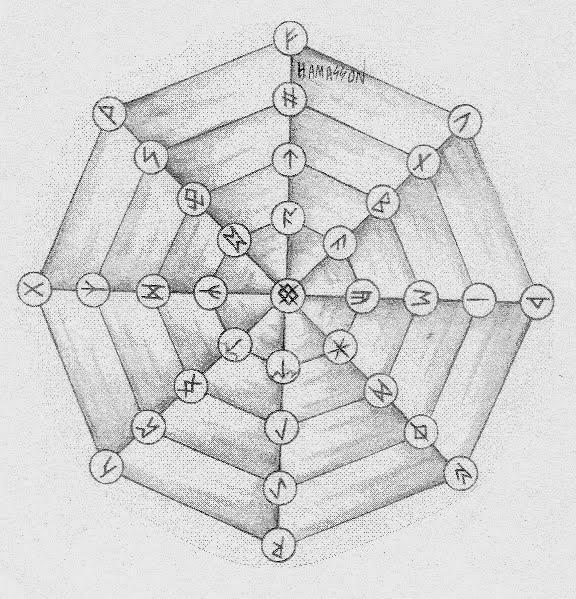
The Rune-Web

 
The Rune-Web was drawn by Hamasson of Woden's Folk some years ago, for use in our magazines. It is perhaps time that we made a deeper study of this, since it is an important image for Rune-Workers. I have to add that this is just one way that the runes can be set, and there are many ways used by WF - each with its own unique importance. Of course, this is a new image, and not (as far as we know) found in any 'tradition' - but the runes evolve!
 
At the Sacred Centre is the Gar-Rune which is the Spear of Woden - Gungnir ('Gift of Ing'). This represents the 'pole' or 'central axis' from which all runes emerge. It would have been this point, the Sacred Centre, that Woden would have had to reach (through a 'mystical death' and 'resurrection') in order to rediscover the runes for us.
 

The photo above is reproduced from an image used by David Icke, and shows the area where the Egyptians recognised as being the seat of the Third Eye. In diagrams of the proposed Order Castle in Wewelsburg, Germany we see that a spear enters the proposed central area, aimed at this very point. It seems plainly obvious that the nature of the new Order Castle was to open the third eye of the Initiates. The Eye of Horus thus seems to depict the Third Eye - what we could call the Eye of the Hero. This is a physical centre that represents a Spiritual Centre, and this point is important.
 
In Wewelsburg 1933 - 1945 A Cult and Terror Centre of the SS we find the plans for the extension of the Wewelsburg Castle, with the semi-circle and 'spear' which penetrates in alignment with the North Tower. It is impossible to miss the shape of the Spear entering the Gral. In Tantric Lore the aim is to unite the Serpent Goddess (Shakti) with the god Shiva, and thus open the Third Eye. Thus the Gral (at one level) refers to the uniting of the Hero-Valkyrie opening the Third Eye. Since this project was meant to be the Centre of the World it would seem that the opening of the Third Eye was a 'world project'.
 
There are 32 more runes scattered orderly around the Rune-Web (8 x 4) which makes for a very orderly pattern of 4 x first rune, 4 x second rune, etc. starting from the outside. The 33 - rune English rune-row is used. Rather than the runes being in straight eights, they are placed in a cyclic form moving clockwise around the web, and starting at the top with the next eight. These are the rune-names used within the Ar-Kan Rune-Lag -
 
Feoh
Ur
Thorn
Os
Rad
Ken
Gyfu
Wyn
 
Haegl
Nyd
Is
Ger
Eoh
Peorth
Eolhs
Sigel
 
Tir
Beorc
Eh
Mann
Lagu
Ing
Daeg
Edel
 
Ac
Aesc
Yr
Ior
Ear
Cweord
Calc
Stan
 
 
Gar
 
There are variations to the certain runes, and different names are used too; these are the main runes that have variants -
 
Ken
Yr
Cweorth
Stan
Gar
 
Different rune-names can be used for runic-gealdor since certain runes have very different meanings (on the surface), for example -
 
Sigel - The Sun, Solar Power, Solar Force.
Sowilo - the Soul, shape-shifting, soul-travel.
 
We can see that the runes are far from static and must be used in different ways to produce certain results. There are certain simple rules to rune-magic -
 
1. Visualisation of the Rune.
 
2. Gealdor - Sounding of the Rune.
 
3. Will - Sending of the Rune through the Force of Will.
 
Perhaps the most important thing is - intent. Without this no result can ever be expected, and doing rune-chanting for the sake of rune-chanting can be dangerous. Some occultists warn not to use 'lust for result' but this does not mean what I have said, for there has to be something that the work is undertaken, and this has to be a result from the working. What these people mean is not to dwell on the result, but to use the Force of Will to send the runic-power, and not dwell on it after.
 
We have used runic-gealdor-visualisation with groups of people at Folk-Moots, but this has been used in a way to achieve results within the group - lifting the 'spirit' of the group, which it certainly does. But for other runic gealdor the better way is to use a specific group trained in magical arts, since it takes years to do so and more experience is needed so that dangerous forces are not invoked - or the work rebounds back, which is certainly true of any form of negative magic. This is why it is always wise to use a positive magic that causes a change.
 

We have used the Nine Glory-Twigs in teaching and this is a Mother Rune out of which all 33 runes are obtained. Once again, Woden discovered the runes, and he would have lifted them out of the Mother Rune or Primal Pattern. It can be no coincidence that a Secret Rune-Row given to a Woden Initiate a few years ago also fits into the above pattern. We can only assume from this that since these are not 'traditional runes' (like the Armanen Runes) the pattern contains an infinite number of rune-shapes that can be 'discovered' by future rune-workers. The centre of this is once again the Gar-Rune.
 
Now are Har's sayings   spoken in Har's Hall,
of help to the sons of men,
of harm to the sons of the Jotun....
 
The 'Sayings of Har' 165.
 
Here we are told clearly that the runes were discovered by Woden for his own Northern Folk that they may aid them, but they would cause harm to the Jotun. The name of Woden here 'Har' is said to mean 'High One' (Sturlasson) but it is rooted in the same as hari/heri and related to the Hero-God - God of the Mannerbunde.


Monday, 28 July 2014

The Berserker

The usual meaning of the phrase 'to go berserk' is that of someone who loses his temper and is not in control of himself. This stems from the idea that the Viking Berserker (where the phrase stems from) fights in a state where he is not in control of himself. This idea is enforced by the idea that this type of warrior fought under the influence of the Amanita Muscaria or Fly Agaric mushroom - the red-capped mushroom found under the birch or pine tree usually. It is certainly true that the German name of this mushroom contains the idea of the Berserker. Whether this is evidence to prove this or not is open to question.


But there is reason to doubt these ideas, since anyone who is not in control of himself would hardly be in a position to hold up in battle as well as someone who is in complete control and is calm and aware of what is going on. In any case the Amanita Muscaria seems to enhance awareness and focus consciousness, and not take the individual into a state of anger and loss of control. We have this quote from the famous film-star and martial artist, Chuck Norris - 'Men are like steel, if they lose their temper they lose their worth'. It is never in the interest of any warrior to lose control through losing his temper. The Berserkers were often bodyguard to a king, so their role would be one of protection, where calm and awareness would be essential.
 
It is more likely that a controlled rage was the key to the secret of the Berserker, a rage that is deliberately invoked by various means -
 
1. Perhaps by working on a punch-bag or the like which is hit over and over again as a rage is built up.
 
2. This could be enhanced by visualising someone that one hates to such an extent that anger and rage is built up through 'hitting' this person over and over again. Here a good deal of self-control would be necessary so as not to lose control altogether.
 
3. The repetition of this type of exercise would result in being to invoke such a state at will, without the need to go through the whole process first.


All this, of course, is mere guesswork but it does seem to make more sense than seeing the Viking Berserker as some form of 'violent thug', which is how this figure is often portrayed. In any form of Martial Arts the individual goes through a strict training process, and through set forms and movements, all of which enhance his power and ability to fight. The Viking Warrior would also have had some form of Martial Arts training, since this is all part of the process of building the warrior. It would perhaps be true to say that the young warrior may have had bouts of temper and loss of self-control (as in the tale of Egil Skallagrimsson) but this would not be true of the more experienced, mature warrior who would have created the Calm Centre and thus acted like the Eye of the Storm. 


Wednesday, 16 July 2014

Evolution of the Runes

The runes are not static and unchanging, and we should not forget that Woden did not create the runes (which already existed), for he rediscovered them through undergoing a shamanic initiation. We have meanings for the runes passed down to us, but they are heavily influenced by Christianity, coming to us during the early parts of the growing influence of the Judaeo-Christian Church. It would certainly be highly unlikely that the magical application of the runes would come down to us during this time, since this is where the Christian Church stamped down hard upon. What we have left is a set of rune-poems from different areas of the Northlands which are Christian in form and which have very mundane and everyday meanings.
 
If we look at the Greek and Hebrew alphabets we find that the letters also have names, again very mundane in meaning, but which also have a number and a hidden meaning which can be found in the Mystery Tradition of each particular culture. We can safely assume that the runes have a similar status which has been almost lost to us due to centuries of suppression. If we reject the idea that certain individuals are able to contact the inner meanings of the runes through intuition, meditation and other rune-work, then these meanings would be completely lost forever. Guido von List showed how these inner meanings could come to light again, and since then others have followed on and the runes are again evolving within the Folk-Consciousness. There is growing proof that the runes lie deep in the consciousness of the Folk, and that certain individuals can tap into this consciousness to gain new insights into their meanings.
 
The process of evolution is not done by one single individual, but by many different individuals working perhaps as facets of the Woden-Consciousness, rediscovering the runes as Woden did on the Wolf-Tree. As one individual finds new meanings others can see further insights, and the process goes on and on - all within the growing movement of Wodenism/Wotanism/Odinism. The runes are thus not stuck in a bygone era of time, the time of the 'Anglo-Saxons' or the 'Vikings'; if this were so they would be of no use to us today.
 
We have ample proof of the changing nature of the rune-meanings, so one example should suffice for this post. The meaning of the Feoh-Rune is 'cattle', pretty mundane and down-to-earth. What we need to consider is the essence of the meaning, and not just the form, for the runes are symbols. Cattle was the original measure of wealth within a tribe, which (as the different rune-meanings show us) altered by the Viking era into gold. Both were, to an extent, a measure of exchange between individuals or groups. The essence of this rune is thus exchange - something passed from one to another. From this we get another measure of exchange - the 'fee', a word that derives from the rune-name Feoh. From the original means of barter we have gold or silver as a means of paying for an exchange, from which came 'money' and today 'credit' on a grand scale. The system has gradually degenerated until money can be made from money, and indeed wealth can be made from nothing in a system of credit or 'usury' (money-lending with interest). The idea of 'usury' broke the basic idea of exchange since nothing is actually passed from one to another, the only meaning being that of gain without any work involved at all.
 
But we should not stop at physical meanings for each rune, since they have inner meanings that are not apparent until the symbol is studied and meditated upon. The first letter of the Hebrew Alphabet is Aleph which means 'cattle' - coincidence? The Greek Alpha has a similar sound too, and is also the first letter of their alphabet. As stated before, both in Hebrew and Greek the letters also have hidden meanings that were known only to a few esoteric workers in each tradition. This would also be the case with the runes. So we cannot stop at the mundane meaning of 'cattle' or of 'gold'. It would seem clear from the child's tale of Jack & the Beanstalk - based upon this Feoh-Rune - that this represents a Solar Initiation in which Jack gains the Solar Knowledge through undergoing a series of trials, stealing the knowledge from an 'ogre' - or rather taking it back since at the end we find that the 'ogre' had stolen it from Jack's father. As well as this being an Initiation Rite it is also a dim remembrance of the Aryan Myth in which the treasure (cattle or gold) is stolen from the Arya by the Jotun ('ogre' in this case) and regained by the Sun-Hero.
 
Nowhere in any of the rune-poems do we find reference to a Gealdor - Fe-Fi-Fo-Fum - which can be found in this tale. But we do find reference to 'gold' which can also be found in the tale of Jack & the Beanstalk - golden hen, gold coins, and golden harp - and gold has always been as Solar Symbol. From the mundane meaning of 'cattle' and 'gold' we have come to an inner meaning associated with Solar Knowledge. Horns have always been associated with the divine and would seem to represent a penetration into other worlds of being - a 'breaking through'.


Here we find a Boar with 'tusks' which have the same symbolic meaning as 'horns', and in the figure below (from the Horns of Gallehus) we have a horned figure -


This figure, on a runic horn, contradicts the idea that a Horned God was never part of the Northern Tradition, as does the die-cast shown below (from Sweden) -


In this one we can see clearly that the 'horns' of the 'dancing-warrior' are clearly symbolic, ending in bird's heads. There are also 'Solar-Horns' and 'Lunar-Horns' in a state of balance. A close-up of the die-cast shows the right-eye missing which could be a flaw, but there are also other figures with the right (or left in some cases) eye missing. This could thus be Woden - the One-Eyed Hunter-God. Woden is the most ancient Wolf-God and here we see an Ulfhednar Warrior.
 
The bull ('cattle') was in some ancient cultures symbolic of the Sun and thus of Solar-Power. This links it directly to the 'gold' of the other rune-poems, and thus the 'wealth' is really that of the Solar Knowledge of the Arya. The term Arya actually stems from the Aryan Root *ar- which means 'to move' (the Sun's perceived movement across the skies) but also 'to plough' which suggests the work done by oxen ('cattle'). The very basis of the keys to the Aryan Mysteries lies in the theft of the Solar Knowledge and its retrieval by the Solar Hero. This is thus the Primal Rune which contains this Primal Knowledge which is at the core of our struggle. We can see the symbolism clearly in Jack and the Beanstalk where the 'ogre' steals the gold objects from Jack's father, and Jack goes through a series of trials in order to regain what is rightly his.
 
In the Persian (Iranian-Aryan) version Kau Khusrau is the rightful owner of the Hvareno but the Turanian ruler steals the 'Glory' which belongs to the Aryan Nations and it is Kau Khusrau who has to regain it. We find this reflected in the Norse tale where Loki steals the Brosingamen Necklace from the goddess Freya which is regained by Heimdall (Hama) after a series of trials. We should reflect that the rune-name Feoh has roots in words meaning 'fire' and 'light' and that we have here Fire (Hama) pitched against Fire (Loki). Indeed, the Necklace of Fire is regained from the element of Water - from a lake in both cases. This is the secret of Fire from Water and the Great Deep. The Glory of Light is associated with the Sun and of Solar Kingship.
 
The Glory of Light is held by the goddess named Ardvi Sura Anahita just as the Necklace of Fire (Brosingamen) is held by the goddess Freya. The Feoh-Rune is not only the 'Father-Rune' but is also connected to the goddess Freya and to the Waene-Gods. The Waene are associated with the planet Venus (The Morning Star & Evening Star) which is the herald of the Sun, the Dawn, and the Twilight Hour.
 
We have seen here, just by widening the view of one rune we can find numerous new meanings and new interpretations - all individual interpretations but nonetheless valid ones that aid our knowledge. No matter how many thousands of ancient books, documents, and knowledge are destroyed at a physical level these symbols remain in the Blood Memory of our Folk and can be brought to the surface by those who work at an esoteric level. The runes are ever-changing and ever-evolving just as we are evolving.